
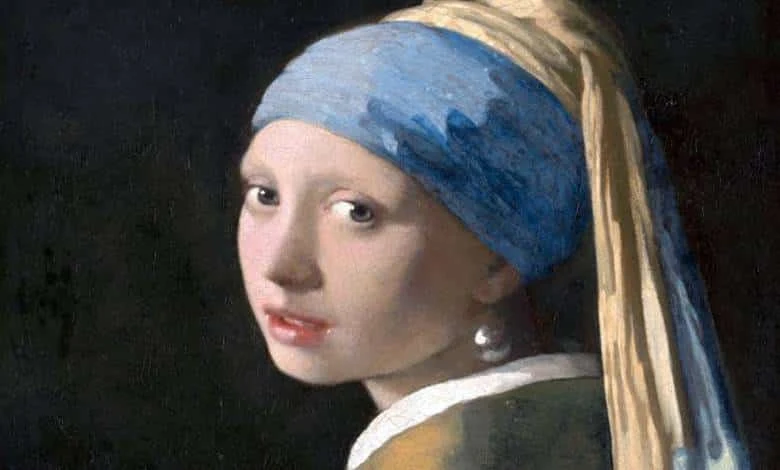
Johannes Vermeer's Girl with a Pearl Earring, painted in 1665 and housed at the Mauritshuis in The Hague, is one of the most recognizable paintings in the world, captivating millions with its intimate gaze and luminous pearl. The portrait of an anonymous young woman has become a cultural touchstone, bridging the gap between old master painting and modern pop culture in a way that few artworks ever achieve. It is a face that stops you mid-stride, a quiet moment of connection that feels both deeply personal and utterly timeless.
The short version
Painted by Johannes Vermeer in 1665, Girl with a Pearl Earring is an oil painting on canvas, now in the collection of the Mauritshuis museum in The Hague. The identity of the girl is unknown, and the painting's fame rests on its captivating gaze, masterful light, and the enduring mystery surrounding its subject.
- Johannes Vermeer painted Girl with a Pearl Earring in 1665, during the Dutch Golden Age.
- The painting has been part of the Mauritshuis museum collection in The Hague since 1902.
- The identity of the girl in the portrait remains unknown, adding to its enduring mystery.
- The artwork is widely known as the "Mona Lisa of the North" due to its enigmatic appeal.
- The painting's fame surged after Tracy Chevalier's 1999 novel and the 2003 film adaptation, both titled after the artwork.
The Mona Lisa of the North: Why a Small Portrait Became a Legend
Johannes Vermeer's Girl with a Pearl Earring, painted around 1665, has become the most recognized portrait in the world after Leonardo da Vinci's Mona Lisa from circa 1503. That comparison earned it the nickname "the Mona Lisa of the North." Today, this modestly sized canvas hangs in the Mauritshuis Museum in The Hague, where it has lived since 1902.
The painting measures barely larger than a sheet of paper, yet it draws more visitors than nearly anything else in the Dutch capital's art scene. People queue for hours just to stand before a teenage girl in a blue-and-yellow turban, her lips slightly parted, her eyes locked on whoever happens to be looking back. She holds no objects, tells no story, and offers no clues about who she might be. That silence, it turns out, is exactly what makes her unforgettable.
Art historians date the work to approximately 1665, though the exact year remains a matter of scholarly debate. What is not debated is the painting's strange pull on the human brain. A 2017 neuroscience study with 20 volunteers found that the original canvas triggers what researchers call a "Sustained Attention Loop" - your eyes bounce from her gaze to her lips to the pearl and back again, making it physically difficult to look away. The same study found that seeing the real painting in the museum produces an emotional response ten times stronger than viewing a poster or print. The precuneus, a brain region tied to consciousness and self-awareness, lights up with unusual intensity.
Part of the legend was built in the popular imagination. Tracy Chevalier's 1999 novel Girl with a Pearl Earring imagined the life of the mysterious model, and the book became a bestseller. Hollywood turned it into a film in 2003, and a stage adaptation followed in 2008. The story gave the silent girl a voice, even if that voice was entirely invented.
What makes the painting so singular among Vermeer's work is its departure from his usual scenes. The Dutch master produced only a small number of paintings in his lifetime, most of them quiet domestic interiors filled with windows, floor tiles, and furniture guiding your eye through a room. The Girl with a Pearl Earring breaks that pattern. There is no room here, no furniture, no story unfolding. Just a dark void, a face, and a single gleaming pearl.
Technical examinations have revealed something surprising beneath that dark background. Vermeer originally painted a green curtain behind the girl, then covered it with layers of dark pigment. The overpainting created the stark, theatrical contrast that makes her face glow like a candle in a dark room. He wanted her alone in the dark, and he worked to make sure she stayed that way.
Women dominate Vermeer's surviving oeuvre - female figures appear in his works roughly 40 times, while male figures show up only about 14 times, according to some counts. But none of those women turned their heads the way this girl does, looking over her shoulder as if someone just called her name. That moment of interruption, frozen in oil paint, is the hook that has held audiences for over three centuries.
A Gaze That Haunts: The Mystery Behind the Girl's Face
The first thing that stops you in front of Johannes Vermeer's Girl with a Pearl Earring is the way she looks back at you. Her body is turned away, caught mid-motion, but her face has swung around to meet your eyes directly, and that contradiction creates the painting's magnetic pull. It is an intimate moment frozen in 1665, yet the girl keeps her distance, leaving you uncertain whether she is inviting you closer or silently telling you to stay back.
Her mouth is the quietest detail in the whole composition. The lips are full and painted with a wet-looking sheen, but they are not smiling. They are simply there, neutral, poised on the edge of speech or silence. That near-absence of expression does something strange to the viewer: it makes the portrait feel alive, as though she might say something any second, while also keeping her completely unreachable. The ambiguity is deliberate, and it is why people have spent centuries trying to decode her.
Vermeer gave her skin a smooth, porcelain finish, almost unreal in its perfection, and framed it with bright, oversized eyes that lock onto yours. Those eyes are the anchor of the entire piece. They hold a kind of directness that feels personal, as if the girl knows you are standing there, yet they reveal nothing about what she is thinking. That tension between invitation and withdrawal is what makes the gaze so haunting.
Who she actually was remains unknown. It is possible that a real model posed for the painting, but many art historians and writers believe Vermeer idealized the figure, shaping her into something more than a specific person. She might represent an idea, a mood, or a type of beauty rather than a portrait of an individual. The mystery of her identity only deepens the effect of that stare, because we cannot pin her down, and so she remains forever elusive.
Chiaroscuro and Lapis Lazuli: How Vermeer Built the Magic
The magic of the Girl with a Pearl Earring begins with a trick of light. Vermeer painted the young woman against a background that is almost completely black, and that darkness does something remarkable: it pushes her forward like an actor standing alone under a spotlight.
Light pours in from the right side of the canvas, catching her pale, luminous skin and the bright fabric that flows from her head down to her shoulder. That single directional beam gives the figure volume, a convincing three-dimensional presence that makes her feel almost tangible. Her eyes, her lips, and the pearl itself all catch that light in ways that seem impossibly delicate.
The blue turban deserves its own moment of attention. Vermeer painted it with lapis lazuli, a pigment ground from a semi-precious stone that was more expensive than gold in the seventeenth century. Against the yellow of her dress, that deep blue creates a color contrast that is both bold and harmonious.
Here is a detail that technical examinations have confirmed: Vermeer originally painted a green curtain in the background of this very painting. At some point during the creative process, he decided to cover that curtain with dark colors, burying it beneath the shadowy void we see today. The decision transformed the composition entirely, trading a domestic setting for something far more mysterious and timeless.
An Outlier in Vermeer's Oeuvre: Not Your Typical Interior Scene
Johannes Vermeer, the Dutch painter who worked in Delft from 1653 until his death in 1675, left behind a remarkably small body of work, and nearly all of it looks nothing like Girl with a Pearl Earring. The artist who gave us this iconic close-up portrait spent most of his career painting domestic interiors, scenes built around floor tiles, sunlit windows, and carefully arranged furniture that pull your eye deep into a room. His women pour milk, read letters, weigh gold, and pause mid-conversation, all framed by the quiet geometry of 17th-century Dutch home life.
Then there is this girl. No tiles, no window, no table. Just a young woman turned over her shoulder, her face nearly filling the canvas, emerging from a void of darkness. The composition strips away every narrative clue Vermeer's other paintings lean on. What remains is pure simplicity, restraint, and an elegance that needs no props. It is a radical departure for an artist whose surviving oeuvre numbers only around 34 to 37 paintings, and it stands apart precisely because it refuses to show us anything but her.
Vermeer's world was overwhelmingly female, at least on canvas. In the works that survive today, women appear roughly 40 times while men show up only about 14 times, according to counts that circulate in art histories, though the exact tally is hard to pin down. The Girl with a Pearl Earring fits that pattern, but she breaks every other rule the painter set for himself. No domestic chore, no interior setting, no story to decode. Just a face, a turban, and that impossible pearl.
Curiously, this masterpiece did not always command the attention it receives today. During Vermeer's lifetime, the painting reportedly drew nowhere near the interest of his other works. As the story goes, it vanished from public view for more than two centuries, though records actually show it surfaced at an auction in 1881 and found its way to the Mauritshuis Museum in The Hague in 1902, where it has hung ever since. Whatever the exact path, the painting's rise from obscurity to global fame is as mysterious as the girl's half-open lips.
Pop Culture Rebirth: From Tracy Chevalier to Banksy
In 1999, British author Tracy Chevalier published a novel that would change how the world saw this 17th-century Dutch painting forever. Girl with a Pearl Earring imagined the life of the young woman in Vermeer's portrait, giving a fictional identity to a face that had stayed silent for over three centuries. The book became a bestseller, and Hollywood came calling quickly.
The story made its way to the big screen in 2003, with Scarlett Johansson playing the fictional Griet opposite Colin Firth as Vermeer. Five years later, in 2008, the same story was adapted for the stage. Each retelling pulled new audiences back to the original canvas hanging in the Mauritshuis Museum in The Hague.
Then came the street artist Banksy. In 2014, he created his own version of the iconic portrait, swapping the pearl earring for an alarm device. Contrary to some versions of the story, the Turkish title "Piercingli Kulak Memeli Kız" is not an official name for this work, and reports of a pandemic-era mask added to the image are not documented. What is certain is that Banksy's parody, along with countless other homages and references, has kept the Girl with a Pearl Earring firmly planted in popular culture.
These modern reinterpretations do more than just pay tribute. They force new generations to ask the same question that has puzzled art lovers for years: who is she, and why does she keep pulling us back?
The Neuroscience of Fascination: The Sustained Attention Loop
In 2017, a team of neuroscientists did something no one had ever tried before: they put twenty volunteers in front of Johannes Vermeer's Girl with a Pearl Earring and measured what actually happened inside their brains as they looked. The results were startling enough to make headlines, because they suggested the painting's famous pull is not just aesthetic taste. It is a hardwired neurological event, a loop your brain gets caught in whether you want it to or not.
The researchers called it the "Sustained Attention Loop." Watch someone's eyes while they study the portrait and you will see the pattern repeat: first they lock onto the girl's gaze, then their pupils drift down to her lips, then over to the pearl earring, and then back up to her eyes again. The cycle keeps circling, and each revolution seems to refresh the viewer's interest rather than exhaust it. The longer people looked, the deeper their emotional and cognitive engagement became, which helps explain why visitors to the Mauritshuis in The Hague can stand in front of this small canvas for minutes at a time.
The brain imaging added another layer to the mystery. During the viewing sessions, a region called the precuneus lit up with high activity. That area is tied to consciousness and self-awareness, which suggests the portrait somehow pulls the viewer into a personal, almost introspective encounter. Vermeer's girl is not just being looked at. She seems to be looking back, and your brain registers that exchange as something meaningful.
There is one more finding that might surprise anyone who has only seen reproductions. The same 2017 study compared reactions to the original painting against reactions to a poster or print, and the difference was enormous: viewing the real canvas in the museum produced an emotional response roughly ten times stronger than viewing a copy. Some of that power is the physical presence of the paint itself, the way light hits the actual surface. But part of it, the researchers argue, is the loop, the way your eyes keep returning to her eyes, her lips, the pearl, and back again, a circuit that refuses to let you go.
Frequently Asked Questions About Girl with a Pearl Earring
What makes Girl with a Pearl Earring so special?
Girl with a Pearl Earring captivates viewers through its mysterious, direct gaze, dramatic chiaroscuro lighting, and a neurological phenomenon called the "Sustained Attention Loop" that locks your eyes in a repeating cycle. These elements combine to create an intimate, almost hypnotic connection between the young woman and anyone who stands before her.
Johannes Vermeer painted this small portrait around 1665, during the Dutch Golden Age. Unlike his other works, which typically show people inside detailed rooms, this one strips everything away. The dark background, the turban, and that single glowing pearl do all the work. The girl turns back over her shoulder, her lips slightly parted, her eyes meeting yours with an expression that feels both inviting and distant. That ambiguity keeps people guessing, and guessing, for centuries.
Why is Girl with a Pearl Earring called the Mona Lisa of the North?
Art lovers and critics have long called Girl with a Pearl Earring the "Mona Lisa of the North" because it is widely considered the most famous portrait after Leonardo da Vinci's Mona Lisa, painted around 1503. The nickname captures how this Dutch painting holds a similar cultural status across Europe and beyond.
Both portraits share that elusive quality: a subject whose thoughts remain completely unknown. The Mona Lisa smiles with quiet confidence; Vermeer's girl offers something harder to name. She is not smiling, exactly, but her expression is far from blank. That parallel, plus the sheer fame both works enjoy, made the comparison stick. When people refer to the Northern Mona Lisa, they mean this painting, hanging in The Hague.
Who is the girl in Girl with a Pearl Earring?
No one knows the identity of the girl in Girl with a Pearl Earring. She may have been a model who posed for Vermeer, but many art historians believe the artist idealized the figure rather than painting a specific person. The mystery is part of what makes the portrait so compelling.
Vermeer gave her flawless porcelain skin, glossy red lips, and bright, large eyes that lock onto the viewer. She wears a blue and yellow turban and a pearl earring so luminous it seems wet. Because no records identify her, she has become a symbol rather than a person, an idea of youth and beauty frozen in paint. Tracy Chevalier's 1999 novel invented a fictional life for her, imagining a servant girl in Vermeer's household, but that story remains pure imagination.
How does Girl with a Pearl Earring affect the brain?
A 2017 neuroscience study with 20 volunteers found that viewing the original Girl with a Pearl Earring triggers a "Sustained Attention Loop" and activates the precuneus region of the brain, which is linked to consciousness and self-awareness. The same study reported that seeing the original in person produces an emotional response about ten times stronger than looking at a poster.
Researchers tracked the volunteers' eye movements and brain activity while they stood before the painting. The results showed that the longer someone looked, the deeper their emotional and cognitive connection became. The precuneus lighting up suggests the painting touches something personal in each viewer. This helps explain why the portrait feels so alive, why people describe being unable to look away, and why reproductions simply cannot replicate the experience.
Where is Girl with a Pearl Earring displayed?
Girl with a Pearl Earring is displayed at the Mauritshuis Museum in The Hague, where it has been part of the collection since 1902. The painting arrived there after being sold at auction in 1881 and later donated to the museum.
The Mauritshuis is a small, intimate museum housed in a 17th-century palace, which suits this quiet portrait perfectly. Visitors from around the world queue up to spend a few moments with her. The museum has made the painting the centerpiece of its collection, and it rarely travels anymore because of its fragility and fame. If you want to see her in person, The Hague is the only address that matters.
What is the Sustained Attention Loop in Girl with a Pearl Earring?
The Sustained Attention Loop is a neurological phenomenon in which a viewer's eyes cycle repeatedly between the girl's eyes, her lips, and the pearl earring, keeping attention locked on the painting. This repeating visual pattern makes it difficult to look away and deepens the emotional connection with the portrait.
When you first glance at the painting, your eyes land on her gaze. Then they drift down to her parted lips, then over to the gleaming pearl, and back up to her eyes again. The triangle formed by these three points creates a loop that your brain wants to repeat. Researchers who studied this effect in 2017 found that the longer viewers stayed in this cycle, the stronger their response became. Vermeer may not have known about neuroscience, but he arranged light, composition, and detail in a way that makes the brain do the rest.
Did Banksy parody Girl with a Pearl Earring?
Yes, the street artist Banksy created a parody of Girl with a Pearl Earring in 2014, replacing the pearl with an alarm device. The work appeared as a mural and became part of the painting's ongoing presence in popular culture.
Contrary to some versions of the story, there is no documented evidence that a mask was added to Banksy's parody during the pandemic. The mural itself, however, fits a pattern of modern artists riffing on Vermeer's masterpiece. Between Tracy Chevalier's 1999 novel, the 2003 film adaptation, the 2008 stage production, and Banksy's street art, the girl keeps appearing in new contexts. Each reinterpretation adds another layer to her story while the original painting remains unchanged, still holding that pearl, still holding our gaze.
Editor's note: Some details about the painting's history and the identity of its subject remain unconfirmed and are presented as such in this article.
What are your thoughts on this topic?
Every article is an open conversation. Whether you have a counter-argument, a local example, or a different perspective based on your own experience, your contribution makes this space better.
0 Comments