
The Nietzsche Upanishads connection runs through Arthur Schopenhauer, whose enthusiastic engagement with these ancient Hindu texts in the early 19th century directly shaped Friedrich Nietzsche's later concepts of the Will to Power and amor fati. Schopenhauer read the first European translation of the Upanishads in 1818, and his resulting philosophy became the intellectual bridge that carried Eastern metaphysical ideas into Nietzsche's work. For readers who have wrestled with Nietzsche's dense, often misunderstood ideas, tracing this hidden lineage feels like discovering a secret passage between two seemingly distant worlds.
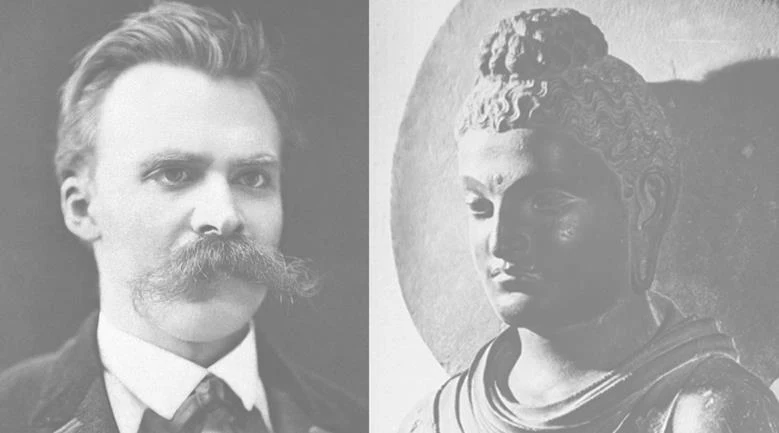
The short version
Nietzsche never read the Upanishads directly, but he absorbed their core themes through Schopenhauer, who openly credited them as the consolation of his life. This indirect influence shaped Nietzsche's ideas on the eternal return, the affirmation of suffering, and the Will to Power, making the Upanishads a quiet but crucial foundation of his philosophy.
- Schopenhauer encountered the Upanishads in 1818 through a Latin translation by Anquetil-Duperron, calling them the most rewarding reading of his life.
- Nietzsche discovered Schopenhauer's philosophy in 1865 at a Leipzig bookshop, a moment he later described as transformative and life-defining.
- The Upanishadic concept of Brahman, the ultimate unchanging reality behind the world of appearances, parallels Nietzsche's later critique of surface-level morality and his search for deeper affirmation.
- Nietzsche's amor fati, or love of fate, echoes the Upanishadic ideal of embracing the cosmic order rather than resisting it, though Nietzsche stripped it of its spiritual framework.
- While Nietzsche eventually rejected Schopenhauer's pessimism, he retained the structural influence of Upanishadic thought, repurposing its insights into his own affirmative philosophy.
The Invisible Eastern Threads in Western Philosophy
Picture the standard story of Western philosophy: it begins on the marble steps of Athens, moves through the salons of Paris, and finds its crowning glory in the lecture halls of Berlin. A self-contained tale of European genius, untouched by outside influence. That picture is an illusion, and the cracks start showing the moment you trace where Friedrich Nietzsche's most radical ideas actually came from.
The nineteenth-century German philosopher Friedrich Nietzsche, who died in 1900, built his worldview on foundations laid by his predecessor Arthur Schopenhauer. And Schopenhauer, in turn, built his on the Upanishads, the ancient Hindu scriptures that emerged in India centuries before the Common Era. The chain runs from the foggy peaks of the Himalayas and the banks of the Ganges river straight into the heart of European metaphysics, even though most philosophy courses never mention it.
Schopenhauer was one of the first major Western thinkers to take Indian and Buddhist thought seriously. He found in the Upanishads concepts that reshaped his entire system: Brahman, the ultimate reality beneath everything; Maya, the veil of illusion hiding that reality; and Samsara, the endless cycle of existence. When he wrote about the Will, that blind, restless, irrational force driving all of nature, he was translating these Eastern intuitions into the vocabulary of European philosophy.
Nietzsche inherited this framework but flipped it. Where Schopenhauer said the Will must be denied to escape suffering, Nietzsche transformed it into the Will to Power and declared that suffering itself is life's most productive force. His concept of amor fati, the love of fate, and his vision of eternal return, where you joyfully affirm the same life over and over, both grow directly from this encounter with Eastern thought, filtered through Schopenhauer's pessimistic lens and then radically inverted.
To understand Nietzsche, you have to pass through Schopenhauer. And to understand Schopenhauer, you have to return to the Upanishads. The invisible threads connecting these thinkers reveal that philosophy has never been the property of a single civilization, but a living fabric woven from exchanges across continents.
Schopenhauer and the Upanishads: A Western Translation of Eastern Wisdom
Arthur Schopenhauer, the famously pessimistic German philosopher of the 19th century, was one of the first major Western thinkers to take Indian and Buddhist philosophy seriously, and his engagement with the Upanishads would go on to shape the intellectual lineage that eventually reached Friedrich Nietzsche. Long before Nietzsche ever put pen to paper, Schopenhauer was reading ancient Sanskrit texts and finding in them a radical challenge to the rationalist tradition that had dominated European thought since the Enlightenment. The Upanishads, a collection of Hindu philosophical texts composed between roughly 800 and 200 BCE, offered him a completely different way of understanding existence.
What struck Schopenhauer most were three interconnected concepts. There was Brahman, the absolute reality underlying all things. There was Maya, the veil of illusion that hides that reality from us. And there was Samsara, the endless cycle of birth, death, and rebirth that traps conscious beings in suffering. Schopenhauer took these ideas and translated them into his own metaphysical system, centered on what he called der Wille, or the Will. He described the Will as a blind, insatiable, irrational force at the core of the world, driving everything from the growth of plants to the ambitions of emperors, never satisfied, always hungry for more.
This was a direct challenge to the optimistic rationalism of his contemporaries, particularly Hegel, who saw history as the progressive unfolding of reason. Schopenhauer instead placed the serene silence of the Buddha at the heart of his philosophy. His system has often been described as reading almost like a Western version of Buddhist sutras, a comparison that captures how deeply Eastern thought shaped his outlook. Life is essentially suffering, he argued, and liberation comes only through denying the Will, extinguishing desires, and surrendering to the root pain of existence. It is an interpretive lens, to be sure, but one that helps explain why Schopenhauer kept a bust of the Buddha in his study alongside his philosophical works.
Nietzsche's Rebellion: From Will to Will to Power
Friedrich Nietzsche never intended to be a loyal disciple. The German philosopher, born in 1844, took Arthur Schopenhauer's central idea of the Will and deliberately turned it inside out, transforming his mentor's pessimistic vision into something radically life-affirming.
Schopenhauer, writing in the early 19th century, had described the Will as a blind, restless, irrational force at the core of existence. His answer to the suffering this Will produced was stark: reject it. Deny desire. Extinguish wanting altogether, the way Buddhist teachings urge. Nietzsche looked at this prescription and balked. Where Schopenhauer saw a burden to escape, Nietzsche saw fuel to burn.
He took the Will and reshaped it into something he called the "Will to Power" (güç istenci). Suffering was not an error to be corrected or a disease to be cured. It was, in Nietzsche's view, the very engine of growth, the productive tension that forges strength. The goal was never to make pain disappear but to meet it head-on and grow larger because of it.
This is where amor fati enters, the love of fate. Nietzsche insisted that a fully realized life demands saying yes to everything that happens, the crushing defeats and the soaring victories alike. Not resignation, not endurance, but active, joyful embrace. His concept of the eternal return carries the same spirit. On the surface, it echoes the cyclical time of Eastern traditions, but Nietzsche meant something different. The eternal return asks whether you could will your exact same life, with all its agony and ecstasy, to repeat infinitely, and answer with a resounding, celebratory yes.
The distance between the two philosophers could not be wider. Schopenhauer's philosophy points toward quietism and release. Nietzsche's response is a battle cry, a demand to dance with the weight of existence rather than drop it. The student did not continue the master's work. He broke it apart and rebuilt it in his own image.
Why Understanding Nietzsche Means Turning to the Upanishads
To grasp Friedrich Nietzsche's philosophy, you have to pass through Arthur Schopenhauer first, and to grasp Schopenhauer, you have to pass through the Upanishads, the ancient Hindu texts that shaped his worldview. This chain of influence is the hidden engine behind some of Western philosophy's most radical ideas.
Schopenhauer, the 19th-century German philosopher, was among the first major Western thinkers to take Indian and Buddhist thought seriously. The Upanishads struck him especially hard. Concepts like Brahman, the absolute reality behind everything, Maya, the veil of illusion covering the visible world, and Samsara, the endless cycle of existence, carved deep grooves into his philosophical imagination. When he defined the Will (der Wille) as a blind, insatiable, irrational force driving the world, he was translating Eastern intuition into Western conceptual language. This move unsettled Europe's long rationalist tradition, placing Buddhist quietude right across from Hegel's temple of reason.
Nietzsche picked up his mentor's inheritance but refused to simply carry it. Where Schopenhauer said to deny the Will to escape suffering, Nietzsche transformed the concept into the Will to Power. Suffering was no longer a burden to shed but life's most productive dynamic, something to grow with and through. This is why amor fati, the love of fate, sits at the core of his thought. His idea of eternal return, often mistaken for Eastern cyclical time, actually means affirming the same life over and over with joy, not enduring it.
So Schopenhauer imported the operating system from the East, and Nietzsche ran his revolutionary applications on it. This chain demolishes the myth of Western philosophy as a closed, self-sufficient tradition. Philosophy is a cross-continental fabric, woven from invisible threads and silent echoes from distant geographies. To understand Nietzsche, you turn to Schopenhauer; to understand Schopenhauer, you turn to the Upanishads. The most radical Western ideas, it turns out, carry Eastern fingerprints all over them.
Frequently Asked Questions About the Nietzsche-Upanishads Connection
What did Schopenhauer take from the Upanishads?
Arthur Schopenhauer, the 19th-century German philosopher, drew the concepts of Brahman, Maya, and Samsara from the Upanishads. These shaped his central idea of the Will as a blind, irrational force driving all of reality. He was among the first major Western thinkers to seriously engage with Indian and Buddhist thought.
Did Nietzsche read the Upanishads directly?
The available records do not confirm that Friedrich Nietzsche read the Upanishads directly. Instead, the influence reached him through Schopenhauer's mediation. Nietzsche encountered Eastern ideas filtered through his predecessor's philosophical system, which is why tracing this connection means following the chain from Nietzsche back to Schopenhauer, and from Schopenhauer back to the Upanishads.
How did Schopenhauer's idea of the Will differ from Nietzsche's?
Schopenhauer saw the Will as something to deny in order to escape suffering, a pessimistic stance influenced by his reading of Eastern texts. Friedrich Nietzsche transformed this concept into the Will to Power, embracing suffering as a productive and necessary force in life. For Nietzsche, the goal was not to extinguish desire but to grow stronger through it.
What is the relationship between Nietzsche's eternal return and Eastern cyclical time?
Nietzsche's eternal return may superficially resemble Eastern cycles of time, but it means something quite different. Rather than merely enduring a repeating cycle, the eternal return demands that one joyfully affirm the same life over and over. This connects to his broader philosophy of amor fati, the love of fate, which stands at the heart of his affirmative worldview.
Editor's note: Some details regarding the extent of Nietzsche's direct familiarity with specific Upanishadic verses remain unconfirmed and are presented as such.
What are your thoughts on this topic?
Every article is an open conversation. Whether you have a counter-argument, a local example, or a different perspective based on your own experience, your contribution makes this space better.
0 Comments