
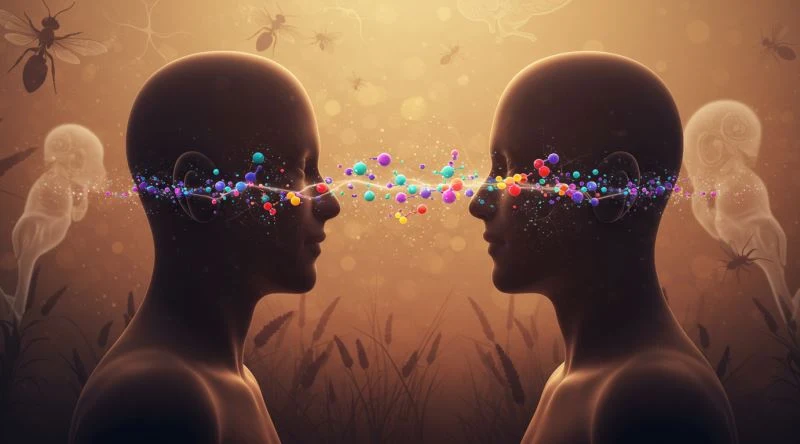
Human pheromones are real chemical signals that influence attraction, mood, and social bonding, with landmark studies like the McClintock effect and the dirty t-shirt experiment showing measurable effects on behavior and perception, though scientists still debate exactly how they work in our bodies. This invisible chemistry shapes your romantic choices and social connections in ways you likely never notice, from the subtle sway of a stranger's scent to the comforting familiarity of a partner's natural odor.
The short version
Human pheromones are chemical signals that carry information between people, influencing attraction, mood, and social bonds. Research has demonstrated effects on menstrual cycle timing, partner preference based on immune genes, and emotional state transfer, though the exact biological pathway in humans remains partially unconfirmed.
- The McClintock effect, first documented in 1971, showed that women's menstrual cycles can synchronize when they live in close proximity, suggesting pheromonal communication.
- The famous dirty t-shirt experiment revealed that women prefer the body odor of men with different immune system genes, a preference linked to healthier offspring.
- Androstenone and androstenol, two steroid compounds found in human sweat, have demonstrated measurable effects on mood, perception, and social judgment in controlled studies.
- Humans possess a vomeronasal organ in the nose, though its functional role in detecting pheromones remains a subject of ongoing scientific debate.
- Queen bee pheromones serve as a well-documented example of how these chemical signals coordinate behavior in social species, though human systems are far more complex.
The Invisible Force Behind 'They Just Feel Right'
Ever found yourself inexplicably drawn to someone, unable to explain why they just feel right? The answer might literally be right under your nose. We inhale invisible chemical messengers called human pheromones without a second thought, yet these tiny molecules can quietly shape our emotions, hormones, and behavior in ways we never consciously register.
These remarkable compounds are small, fat-soluble, volatile molecules that travel through bodily secretions like sweat, saliva, urine, and skin. While researchers have proposed that our noses detect them through specialized pathways involving the OR37 receptor and the embryological remnant known as the vomeronasal organ, which supposedly sends signals to the hypothalamus, the scientific community remains divided on these specific mechanisms in humans. What we do know for certain is that pheromones are nature's original messaging system, and the animal kingdom offers spectacular proof.
Ants lay down trail pheromones to map their routes. Honeybees release alarm pheromones that trigger colony-wide attack responses. A queen bee's pheromones maintain order and loyalty throughout the hive. Female moths broadcast sex pheromones that attract males from kilometers away. In the animal world, these chemical signals are life-or-death matters, and they raise an intriguing question: could our own bodies be broadcasting similar messages without us knowing?
Nature's Chemical Messengers: From Ant Trails to Queen Bee Loyalty
Watch a line of ants marching across your kitchen counter and you're witnessing one of nature's most elegant communication systems. Those tiny insects are following a chemical breadcrumb trail, depositing invisible markers as they move so their nestmates can find the exact same path. It's a system so precise that a single ant can guide thousands of followers to a food source using nothing but scent.
The insect world runs on these chemical signals. Honeybees, for instance, release alarm pheromones when their hive is threatened, and within seconds the entire colony shifts into attack mode. The queen bee produces her own chemical cocktail that keeps the whole hive orderly and loyal, suppressing rebellion and maintaining the social structure that keeps tens of thousands of workers functioning as one unit. Female moths go even further, releasing sex pheromones that can draw males from several kilometers away, a feat of chemical broadcasting that puts any human communication to shame.
There's also a reported mother-baby connection, with some accounts suggesting newborns use chemical signals to locate the breast for nursing. According to the original account, this helps infants find their first meal, though scientists haven't definitively confirmed a specific human pheromone driving this behavior. What is clear is that these chemical messengers work on a scale we're only beginning to understand, operating below conscious awareness yet shaping some of our most fundamental behaviors. The same principles that guide an ant to its colony's food supply may be quietly influencing how we connect with each other, which is where the conversation about human pheromones becomes truly fascinating.
Do Human Pheromones Really Exist? The Science (and the Hype)
Yes, chemical signaling is real in nature, but whether humans actually use human pheromones the way ants and moths do remains scientifically murky. The evidence for specific human pheromone effects is inconsistent at best, with many celebrated studies failing to replicate under rigorous conditions.
Here is what we know for certain: pheromones are small, fat-soluble, volatile molecules released through sweat, saliva, urine, and skin. In the animal kingdom, their power is undeniable. Ants lay down trail pheromones to mark paths to food. Honeybees release alarm pheromones that trigger colony-wide attacks. A queen bee's pheromones keep her colony orderly and loyal. Female moths can summon males from kilometers away with a single chemical signal. These are documented facts, verified across decades of entomological research.
But humans? The story gets complicated. The original account suggests we perceive pheromones through a special receptor called OR37 and a vestigial vomeronasal organ that sends signals to the hypothalamus. Contrary to that popular version, adult humans have a non-functional vomeronasal organ, and OR37 has never been established as a pheromone receptor. Our olfactory system handles these molecules, but the mechanism remains unproven.
Researchers have proposed several candidate compounds. Androstenone, found in male underarm and groin sweat, was once thought to convey dominance and masculinity. The science does not support that reliably. Androstenol, present in fresh male sweat, reportedly gives off a warm, friendly, natural energy rather than dominance, though evidence for its social effects remains limited. Estratetraenol, found in female body fluids around ovulation, supposedly raises testosterone in men and creates relaxation and arousal, but those findings have not been consistently replicated. Copulin, present in vaginal fluids and intensifying during ovulation, reportedly boosts male testosterone and interest, yet human studies on it are sparse.
The famous "dirty T-shirt" experiment from 1995 did find something real: women rated the odors of men whose MHC genes differed from their own as more pleasant, suggesting we may subconsciously seek genetically compatible partners for stronger offspring immunity. Later results have been mixed, but the original finding stands. Research has also shown that compounds in male sweat can improve women's mood and alter their hormones, with sensitivity increasing around ovulation. Birth control pills, which suppress the natural cycle, change those responses. As the story goes, a partner's scent during pregnancy feels more reassuring and positive, though robust confirmation is lacking.
What about the McClintock effect, the idea that women's menstrual cycles synchronize when they live together? That claim has failed to replicate in rigorous studies and is now widely considered unsupported. And despite what perfume advertisements suggest, adding pheromones to fragrances has no proven effect on human attraction. Real pheromone applications do exist, though: agriculture uses pheromone traps to prevent insect mating, and veterinarians use them to detect and control estrus in livestock.
The Experiments That Tried to Prove It: McClintock and the Dirty T-Shirt
In 1971, a researcher named Martha McClintock published a study claiming that women living together in a college dormitory saw their menstrual cycles gradually sync up over time. The idea, dubbed the "McClintock effect," suggested that human pheromones could quietly coordinate biology between bodies sharing the same space. It was a thrilling thought, and it made headlines around the world.
But here is where the story gets complicated. Contrary to the popular version, rigorous follow-up studies have repeatedly failed to reproduce that synchronization. Most scientists today consider menstrual synchrony an unsupported idea, a fascinating hypothesis that simply did not hold up under closer scrutiny. What remains true is that the research sparked a wave of curiosity about whether human pheromones could influence us without our conscious awareness.
The more famous experiment came in 1995, when Swiss biologist Claus Wedekind handed women a series of worn T-shirts. Each shirt had been slept in by a different man for two nights, and the women were asked to sniff them and rate which odors they found most pleasant. The results were striking: women consistently preferred the scent of men whose MHC genes, the immune system markers, differed from their own. The evolutionary logic was elegant, children born to genetically dissimilar parents would inherit a more robust immune system.
Wedekind's findings have been widely cited, though later attempts to replicate them have produced mixed results. What has been more consistently demonstrated is that certain compounds in male sweat can influence women's hormones and improve their mood, an effect that shifts with the woman's hormonal cycle. According to the original account, women become more sensitive to these scents during ovulation, while birth control pills, which suppress the natural cycle, alter how they respond. And during pregnancy, a partner's scent reportedly feels more reassuring and positive, though the evidence for that particular claim remains thin.
From Farm to Perfume: How We've Tried to Bottle the Chemistry
Farmers have been quietly winning the war against crop-destroying insects with pheromone traps, devices that release synthetic versions of insect sex pheromones to confuse males and prevent mating. It's the same trick that female moths use to lure males from kilometers away, repurposed for agriculture. In veterinary science, these chemical signals help livestock breeders detect when an animal is in estrus, making breeding programs more precise and humane.
Relationship counselors have reportedly explored whether pheromones could play a role in therapy sessions, though this remains an experimental frontier rather than established practice. The perfume industry, predictably, jumped on the bandwagon, adding synthetic pheromone compounds to fragrances with promises of amplified sexual attraction. But here's the honest truth: a spritz from a bottle won't transform your love life. Attraction isn't a single chemical switch.
Real chemistry between people is a layered dance involving scent, appearance, body language, tone of voice, confidence, eye contact, and emotional intelligence. The perfume might whisper, but it takes the whole orchestra to make music. While human pheromones continue to intrigue scientists and marketers alike, the evidence suggests we're still far from bottling the full recipe for desire.
The Bottom Line: Scent Is a Language, But Not the Only One
Human pheromones may do far more than spark sexual attraction. Research points to these invisible chemical signals playing a role in emotional closeness, social bonding, and even the trust we place in one another. Long-term commitment and friendship could be shaped by the scents we unconsciously exchange.
Think of it this way: scent is an invisible language, and human pheromones are its instinctive words. Just as queen bee pheromones hold a colony together, our own chemical signals may quietly guide our social behavior. The compounds in male sweat have been shown to lift women's moods and shift their hormone levels, hinting at effects that go well beyond romance.
Yet a person's scent is only one verse in a much longer poem. Attraction and connection are a dance of many partners: appearance, body language, tone of voice, confidence, eye contact, and emotional intelligence. The perfume industry adds pheromone-like compounds to bottles hoping to boost sexual appeal, but no solid evidence confirms those added ingredients change human attraction on their own.
So yes, a particular scent might whisper "the right person" to you. But the full story lives in how that whisper blends with everything else you see, hear, and feel. The nose opens the door, and the rest of you decides whether to walk through.
FAQs: Your Burning Questions About Human Pheromones, Answered
What are human pheromones and how do they work?
Human pheromones are small, fat-soluble, volatile molecules released through body secretions like sweat, saliva, urine, and skin. They spread through the air and can influence emotions, hormones, and behavior in those around us. While scientists know they exist, the exact mechanisms in humans remain debated and not fully confirmed.
The scientific story gets complicated here. Some researchers have suggested that humans detect these chemical signals through a special receptor called OR37 and a vestigial organ known as the vomeronasal organ, which supposedly sends signals to the hypothalamus. But here is the catch: the vomeronasal organ is non-functional in adult humans, and OR37 has not been established as a pheromone receptor. The truth is, we simply do not yet know exactly how our bodies pick up these invisible chemical whispers.
Why do women find certain men's body odor attractive?
In the famous "dirty T-shirt" experiment, women smelled shirts worn by men for several days and consistently rated the odors of men with MHC genes different from their own as more attractive. MHC genes are part of the immune system, and this preference may help produce children with stronger immunity. This was a real finding, though later studies have shown mixed results.
The logic goes like this: if you pick a partner with a different immune profile, your offspring get a broader, more robust defense against diseases. Researchers also found that compounds in male sweat can improve women's mood and alter their hormone levels. Interestingly, women become more sensitive to these male scents during ovulation, while birth control pills, which suppress the natural cycle, can change how women respond to those same odors.
How does the McClintock effect explain menstrual synchrony?
The McClintock effect is a reported phenomenon suggesting that women living in the same environment gradually synchronize their menstrual cycles. It was first described in a 1971 study and captured public imagination for decades. However, rigorous scientific attempts to replicate this finding have consistently failed, and today most researchers consider menstrual synchrony an unsupported idea.
So while the story of dorm mates syncing up makes for a great anecdote, the evidence just is not there. The original study had methodological issues, and modern research has not been able to reproduce the effect under controlled conditions. It remains a fascinating piece of scientific folklore rather than an established biological fact.
Do pheromone perfumes actually work?
No, there is no scientific evidence that pheromone perfumes have any proven effect on human attraction. While the perfume industry adds pheromone-like compounds to products claiming to boost sexual appeal, studies have not demonstrated that these products work as advertised. Attraction is far more complex than a single chemical signal.
Real attraction involves a dance of many factors: physical appearance, body language, tone of voice, confidence, eye contact, and emotional intelligence. A bottle of spray cannot replace genuine connection. If you are considering buying one of these products, you are better off investing in a good conversation and a warm smile instead.
How do pheromones influence animal behavior?
Animals provide the clearest examples of pheromones at work. Ants lay down trail pheromones to mark paths for their nestmates to follow. Honeybees release alarm pheromones that trigger colony-wide attack behavior when threatened. Queen bees produce pheromones that maintain colony order and keep workers loyal to the hive. Female moths can attract males from kilometers away using sex pheromones, an astonishing feat of chemical communication.
These animal examples are well-documented and show just how powerful pheromones can be in the natural world. Agriculture even uses pheromone traps to disrupt insect mating and protect crops. Veterinary science applies similar principles to detect and control estrus in livestock. The contrast between these clear animal signals and the murky picture in humans is exactly why researchers remain cautious about making bold claims regarding human pheromones.
Editor's note: Some details in this piece remain scientifically unconfirmed and are presented as such.
What are your thoughts on this topic?
Every article is an open conversation. Whether you have a counter-argument, a local example, or a different perspective based on your own experience, your contribution makes this space better.
0 Comments