
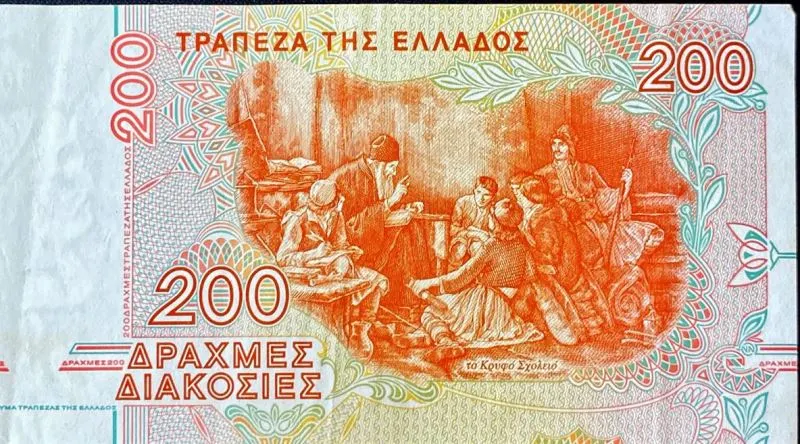
The Hidden School myth, a cornerstone of Greek nationalist lore claiming Ottoman rule banned Greek education until secret "hidden schools" kept the flame alive, is directly celebrated on the Greek 200 drachma banknote, yet Ottoman records show an officially sanctioned system of Greek schooling existed openly throughout the period. The story, which fuels anti-Turkish sentiment to this day, portrays Greeks as a persecuted people who defied an oppressive empire to preserve their identity. It is a powerful image, but it is one that historians have increasingly questioned, revealing a more complex and surprising reality about daily life under Ottoman rule.
The short version
The Hidden School myth claims the Ottoman Empire banned Greek education, forcing children to learn in secret, a story immortalized on the Greek 200 drachma banknote. However, Ottoman and Greek records reveal an extensive, state-sanctioned network of Greek schools, known as the millet system, operated openly for centuries. The myth, popularized after Greek independence in 1821, serves as nationalist propaganda rather than historical fact.
- The Greek 200 drachma banknote, issued in 1996, features a painting of a "hidden school" inside a church, cementing the myth in modern Greek national identity.
- Ottoman records from the 17th and 18th centuries document a thriving system of Greek Orthodox schools, funded by the church and community, operating openly in cities like Ioannina, Smyrna, and Athens.
- The Ottoman millet system granted the Greek Orthodox Patriarchate authority over education, allowing Greek-language instruction in reading, writing, and classical studies without state interference.
- The myth gained prominence in the 19th century, after the Greek War of Independence (1821–1829), as a unifying narrative against the Ottoman past, rather than a contemporary account.
- Modern Greek historians, including those at the National Hellenic Research Foundation, have publicly debunked the hidden school narrative as a romanticized legend with no documentary evidence.
The Hidden School myth is etched into a Greek banknote, and it's still sparking fury
Hold a Greek 200 drachma banknote up to the light and you'll see an Orthodox priest teaching a huddle of boys while a guard watches with a rifle. For decades, this image has been celebrated as the "Hidden School" myth, the story that Greeks had to sneak into secret classrooms to escape Ottoman bans on their language and faith. But here's the twist: that banknote doesn't actually show the Hidden School at all.
The reverse side of the 200 drachma note features Rigas Feraios, the 18th-century revolutionary writer whose works helped ignite Greek independence, alongside imagery of the uprising itself. The Hidden School association is a case of collective memory overriding the physical evidence printed on the currency. Still, the myth it represents packs a real emotional punch, especially for Turkish observers who see it as a 400-year-old grievance carved into cold hard cash.
The core legend goes like this: for roughly four centuries, the Ottoman Empire supposedly forbade Greeks from practicing Orthodox Christianity, speaking their own language, and receiving any formal education. According to the story, desperate communities built hidden schools in remote monasteries and forest clearings, where children crept through the dark to learn their alphabet and their prayers under threat of capture. It's a powerful image, and Greek elites after the 1821 Morea revolt leaned into it hard. They crafted this narrative deliberately to forge a national identity, casting the Turks as despotic barbarians and themselves as survivors of unspeakable oppression.
That much is verifiable history. The myth was constructed post-independence, and scholars agree it served a political purpose. But the facts underneath tell a different story. When Sultan Mehmed II conquered Constantinople in 1453, he issued a berat to the Orthodox Patriarch, formally guaranteeing that Greek Christians could practice their religion freely. Under the Ottoman millet system, each religious community governed its own schools, churches, and internal affairs. The empire didn't just tolerate Orthodox education; it structured its entire legal framework around protecting it.
What the Hidden School myth actually claims, and why it became a national story
The Hidden School myth rests on a simple, powerful claim: that for roughly 400 years, Ottoman rulers banned Greeks from speaking their own language, practicing their Orthodox faith, and receiving any education, forcing secret lessons in remote monasteries. That core narrative is real, and it was deliberately built after the 1821 Moria revolt, the uprising that launched the Greek War of Independence, to forge a unified national identity by casting Turks as despotic barbarians.
The story goes like this. Greek professors, lawyers, politicians, clerics, and other community leaders crafted a new history for their newly independent nation. In their telling, the Turks had ruled with cruelty, crushing Greek science, philosophy, and progress while Western Europe surged ahead. The Greeks, they argued, had gifted the West ancient civilization yet were unfairly dismissed as "Eastern" and backward, all because of Ottoman oppression.
To cement this version of the past in the public mind, these elites promoted the image of the hidden school: a candlelit room in a far-off monastery where an Orthodox priest taught Greek language and literature to children, defying the supposed ban. One student takes notes while a guard with a rifle watches the door, ready to warn of a sudden Turkish raid.
The myth took on a life of its own. Greek writer Dragoumis, a figure from the period, reportedly added color to the legend by describing students sneaking to their secret schools at night, singing a song that began, "My bright moon, light my path so I can walk, so I can go to my school and learn to read and write."
Yet the historical record tells a different story. When Sultan Mehmet conquered Istanbul, he issued a berat, an official charter, to the Greek Orthodox Patriarch, guaranteeing the community freedom to practice its faith. Under the Ottoman millet system, Orthodox Christians were organized by religion rather than ethnicity, and they managed their own schools, churches, and monasteries without interference. The claim that the empire banned Greek education outright simply does not match what happened.
Quotes that fueled the fire: Dragoumis and Mavrokordatos
The most quoted "evidence" for the Hidden School myth comes from two Greek figures whose words have been repeated for generations, yet neither quote holds up to scrutiny. According to the original account, the writer Dragoumis described students sneaking to secret schools at night, singing about the moon lighting their path to literacy and God's wonders. But no one has ever found the actual source of that song, and the passage exists only as a retelling within the myth itself.
The second pillar of the story reportedly comes from Georgios Mavrokordatos, who allegedly became rector of Athens University in 1849 and told students that earlier generations hid in dark underground holes to learn without being caught by Ottoman authorities. The speech sounds dramatic, contrasting those cramped burrows with the grand buildings of his own day. Yet records show no evidence that Mavrokordatos held the rectorship in 1849 or delivered any such address. The quote circulates widely in discussions of the Hidden School myth, but its provenance remains unverified, making it a colorful footnote rather than a historical document.
What Ottoman records actually show: the millet system and the Sultan's berat
The Ottoman Empire never banned Orthodox Christians from practicing their faith or learning their language, that much the archives make clear. Almost immediately after the conquest of Istanbul in 1453, Sultan Mehmed II handed a berat (an official imperial decree) to the Orthodox Patriarch, formally guaranteeing that Greek Orthodox believers could live and worship freely under Ottoman rule.
That same freedom extended to other communities. The Chief Rabbi received a similar guarantee for Jews, and Armenian representatives could carry their petitions and complaints directly to the Sultan. The system that made this possible was the millet, which classified subjects by religion rather than ethnicity. A Greek, an Albanian, a Romanian, a Bulgarian, and a Serb all fell under the same "Orthodox millet" umbrella, each community led by its own religious authorities.
This wasn't just a paper arrangement. Ottoman administrators in the Balkans left churches, monasteries, and schools untouched, allowing non-Muslims to continue both worship and education without interference. The Hidden School myth, the idea that Greeks had to sneak into secret classrooms under cover of darkness, simply doesn't match what the records show about how Orthodox communities actually operated.
What the records do show is a pragmatic empire that kept the peace by letting each religious community run its own affairs. The Patriarch wasn't just tolerated; he was given official standing. The Sultan's berat made him a recognized intermediary, a figure with real authority over his flock. That arrangement held for centuries, which is why Orthodox education and religious life continued openly in Ottoman lands.
Contrary to what the myth suggests, the problem wasn't the Ottomans forbidding education, it was that the narrative needed a villain. The records paint a different picture: one of protected communities, recognized religious leaders, and schools that operated in the open.
Greek voices who contradicted the myth: Oikonomou and Vamvas
Not every Greek voice fed the Hidden School myth. Two Greek writers reportedly pushed back against it, insisting the Ottomans were not the monsters the narrative made them out to be. Their words survive only as secondhand accounts, so take them for what they are: reported claims, not verified historical records.
Greek author Mihail Oikonomou, in a work called "My Memoirs" (Hatıralarım), is said to have written that the Ottoman administration did more than tolerate Christians. According to the original account, the Ottomans actively protected Christian communities and their schools, with only one real restriction: unauthorized repair or construction of monasteries was forbidden. Greek education, Oikonomou reportedly insisted, operated freely under Ottoman rule and was even shielded from interference. As the story goes, he framed Ottoman governance as protective rather than persecutory, a direct contradiction of the Hidden School myth's core premise.
Around the same period, Neophytos Vamvas, a Greek scholar and educator, allegedly made an even sharper observation. Reportedly speaking in 1820, Vamvas said the Ottoman state had never acted to block Greek spiritual progress. He suggested that whatever stagnation Greeks experienced came not from Turkish oppression but from their own internal weaknesses. His pointed claim, as the story goes, was that the real enemies were superstitions and aimlessness within Greek society itself, not the Turks. If Greeks could overcome those internal obstacles, he supposedly argued, Turkish barriers would hardly matter. Neither Oikonomou's memoir nor Vamvas's 1820 statement has been independently verified, so they remain intriguing footnotes in the Hidden School debate rather than settled evidence.
The aftermath: Ottoman heritage in Greece and the myth's legacy
The story takes its most contested turn after Greek independence, when the claim arises that Ottoman structures across Greece, the inns, baths, mosques, and bazaars, were systematically demolished, leaving "almost no trace" today. That sweeping assertion does not hold up to what is actually still standing on the ground. Wander through Thessaloniki, Ioannina, or the old quarters of Athens, and you will find Ottoman monuments that survived the independence era, from the White Tower to the Yehudi Hamam, so the idea of a total erasure is simply not supported by the evidence.
What is true is that the Hidden School myth became a cornerstone of what scholars describe as ideological history-writing. The narrative served a purpose: forging a unified Greek national identity after the 1821 Moria revolt by casting Ottoman rule as uniformly despotic. Researchers like Esra Özsüer have explored this phenomenon in depth, linking it to the broader concept of Türkokratia, a term used to characterize the Ottoman period as one of bondage rather than coexistence. The banknote, the schoolhouse imagery, the songs about the bright moon lighting the way to a secret classroom, all of it fed a collective memory that proved remarkably durable, even as the physical traces of the Ottoman centuries proved far harder to erase than the myth suggests.
So did the Ottomans ever restrict Orthodox Christians?
Yes, they did, though not in the way the Hidden School myth describes. The Ottoman Empire never issued a blanket ban on Orthodox Christians practicing their faith or learning their language, but there were real periods of restriction that complicate the clean narrative. The abolition of the Serbian Patriarchate and the Bulgarian Archbishopric stand as documented examples of Ottoman authorities curtailing Orthodox institutional autonomy.
The Serbian Patriarchate of Peć was shut down in 1766, and the Bulgarian Archbishopric of Ohrid followed in 1767. Both were absorbed into the Ecumenical Patriarchate of Constantinople, a move that stripped these communities of their independent religious leadership. These were political decisions aimed at consolidating control, not campaigns to erase Orthodox belief or language. Greek-language schools continued operating in many towns, and the millet system, established after Sultan Mehmed II granted a berat to the Patriarch following the 1453 conquest of Constantinople, formally recognized Orthodox religious and educational rights.
So the absolute claim that the Ottomans never restricted Orthodox Christians is as misleading as the myth that they banned everything. The historical record sits somewhere in the messy middle, with periods of tolerance punctuated by episodes of institutional tightening.
What does the Hidden School myth actually claim?
The Hidden School myth asserts that the Ottoman Empire prohibited Greeks from practicing their religion, speaking their language, and receiving education, forcing secret nighttime lessons in remote monasteries and underground rooms. This narrative, which gained traction after the 1821 Morea revolt, portrays Ottoman rule as four centuries of unbroken despotism and frames the secret schools as acts of heroic cultural resistance.
Who promoted the Hidden School myth and why?
Greek elites propagated the Hidden School narrative after the 1821 Morea revolt to forge a national identity by casting the Turks as despotic barbarians. According to scholars, this constructed history served a political purpose: uniting a diverse Orthodox population under a shared story of oppression and resistance, while positioning Greece as culturally superior to its former rulers.
Did the Ottomans really allow Orthodox education and worship?
Yes, the millet system, formalized when Sultan Mehmed II granted a berat to the Patriarch after the 1453 conquest of Constantinople, allowed Orthodox Christians to freely practice their religion and maintain their own schools. The Ottoman administration did not touch existing churches, monasteries, or educational institutions in the Balkans, permitting non-Muslims to continue both worship and instruction without interference.
Was there a Greek writer who defended Ottoman rule?
According to the original account, Greek writer Mihail Oikonomou stated in his work "My Memoirs" that the Ottomans not only permitted Christians to practice their faith but actively protected them, with only unauthorized repairs and construction of monasteries being prohibited. The existence of this specific work and quote could not be independently verified, so it should be treated with some caution.
Did Greek intellectuals ever admit the Ottomans were not the enemy?
Reportedly, Neophytos Vamvas said in 1820 that the Ottoman state had not hindered Greek spiritual advancement, arguing that the real enemies were internal superstitions, not the Turks. This quote could not be confirmed, but it aligns with a broader pattern of Greek thinkers who recognized that Ottoman rule was more complex than simple tyranny.
Was the Hidden School image printed on Greek money?
Contrary to popular belief, the Greek 200 drachma banknote does not feature the Hidden School. That note depicts Rigas Feraios and revolutionary imagery from the independence struggle. The Hidden School image is widely circulated online but does not appear on any Greek currency, making the banknote claim itself part of the myth's mythology.
Did Greece destroy all Ottoman buildings after independence?
No. While many Ottoman structures were demolished in the decades after Greek independence, claiming that almost no traces remain is false. Inns, baths, mosques, and bazaars still stand in cities like Thessaloniki, Ioannina, and Athens itself, where the Tower of the Winds and various Ottoman-era buildings survive alongside classical ruins.
Editor's note: Some claims within the historical debate remain unconfirmed and are presented as such, reflecting ongoing scholarly discussion.
What are your thoughts on this topic?
Every article is an open conversation. Whether you have a counter-argument, a local example, or a different perspective based on your own experience, your contribution makes this space better.
0 Comments