
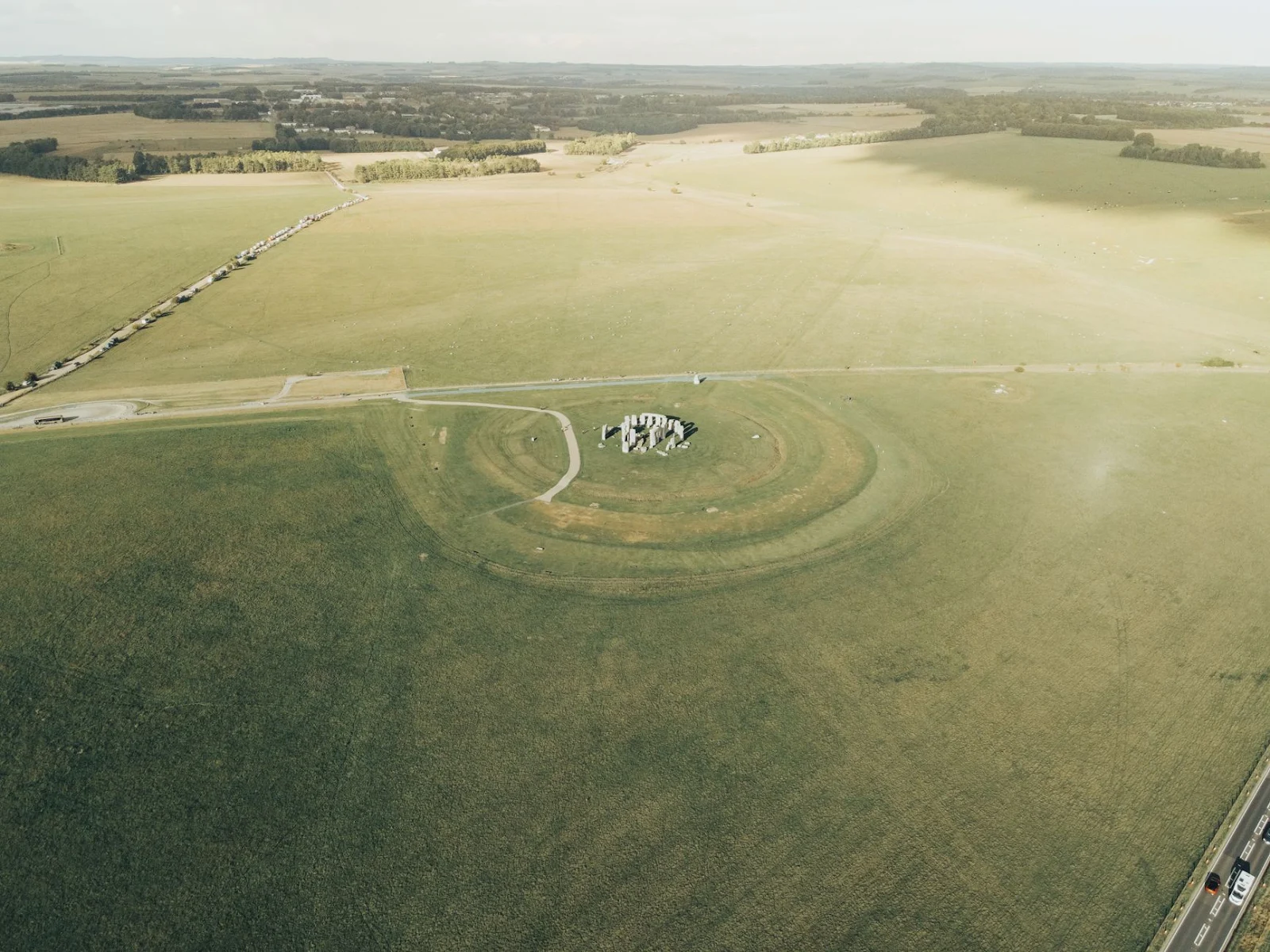
Ley lines are an invisible energy grid connecting ancient sites like Stonehenge and the Great Pyramids, a theory proposed by Alfred Watkins in 1921 but dismissed by science as a product of human pattern-seeking. The idea captivated imaginations for decades, suggesting a hidden network of mystical forces linking sacred landmarks across the globe. Yet, when you dig into the evidence, the lines fade into coincidence, a compelling story of how our brains find meaning in random alignments.
The short version
Ley lines are imaginary alignments of ancient sites, first proposed by Alfred Watkins in 1921. Science explains them as a cognitive bias called apophenia, where humans see patterns in random data. No verified evidence supports an energy grid or ancient purpose behind these alignments.
- Alfred Watkins introduced the concept of ley lines in his 1921 book "The Old Straight Track," based on alignments he observed across the British countryside.
- The theory gained popularity in the 1960s and 1970s through New Age movements, which associated ley lines with mystical energy and Earth mysteries.
- Scientific studies have shown that the alignments are statistically no more frequent than random chance when accounting for the density of ancient sites.
- The St Michael's Ley Line, one of the most famous examples, connects sites like St Michael's Mount and Mont Saint-Michel, but geographers consider it a coincidental alignment.
Ley Lines: Is the Mysterious Energy Grid Wrapping the World Real or an Illusion?
Stonehenge's massive stones, Egypt's Giza pyramids, Peru's Machu Picchu, and Australia's sacred rock Uluru, these four iconic ancient sites are said to be connected by an invisible energy network called ley lines. But are these alignments truly evidence of ancient knowledge, or are they products of the human mind's tendency to find patterns? Scientific data suggests the latter is far more likely.
The concept was first introduced in 1921 by British amateur archaeologist Alfred Watkins. On 30 June 1921, while standing on Blackwardine Hill in Herefordshire, Watkins noticed that some ancient structures appeared to line up perfectly on his map. This "surprising discovery" led him to propose that Neolithic and pre-Roman peoples used straight tracks for trade or ceremonial purposes. In his 1925 book The Old Straight Track, Watkins named these alignments ley lines, borrowing an Anglo-Saxon word that meant a cleared track or pathway, not a forest clearing, as is sometimes claimed.
The 1921 Moment: Alfred Watkins on Blackwardine Hill
On June 30, 1921, a British amateur archaeologist named Alfred Watkins stood on Blackwardine Hill in Herefordshire, gazing across the English countryside, and made an observation that would ripple through popular culture for a century. What he saw that day was not mystical at all, it was a pattern. Watkins, a man with a sharp eye for detail, noticed that ancient structures across the landscape appeared to align in straight lines, as if connected by invisible threads. This was not a vision of energy or magic; it was a practical hunch about how prehistoric people might have moved across the land.
The idea struck him with the force of a revelation. Watkins was an inventor and photographer by trade, not a trained archaeologist, and his mind worked in patterns and systems. As he studied his maps and the view before him, he began connecting hilltops, ancient mounds, churches, and standing stones, not with mystical intent, but with the curiosity of a man who believed the past left physical clues. He called these alignments "leys," borrowing an Anglo-Saxon word that meant a cleared track or pathway. The term itself grounded his theory in the practical world of travel and trade, not in the supernatural.

By 1925, Watkins had fleshed out his idea in a book titled The Old Straight Track, published by Methuen & Co. In it, he proposed that these ley lines were Neolithic and pre-Roman routes, straight tracks used for trade or ceremonial purposes. He even suggested that many Christian churches had been deliberately built on older pagan holy sites that lay along these lines. But the archaeological establishment of the day was skeptical. They pointed out that building straight routes across Britain's hilly, uneven terrain would have been impractical for ancient societies, who would have followed contours and valleys instead. Watkins's theory, they argued, was a desk-bound fantasy, a neat pattern drawn on a map that ignored the messy reality of the land.
Yet the moment on Blackwardine Hill had planted a seed. Watkins himself never claimed anything supernatural, he was a rationalist who saw his leys as functional roads. But the idea that the landscape held hidden alignments, waiting to be discovered, caught the imagination of others. It was a story about connection, about ancient people who might have shared a secret knowledge of geometry and place. And that story, once told, refused to stay buried in the academic dust.
From Straight Tracks to Mystical Grid: How the Idea Evolved
The transformation from Alfred Watkins' practical ancient road theory into today's mystical energy network happened in two distinct leaps. In 1961, a British researcher named Tony Wedd proposed that ley lines could serve as landing routes for UFOs, linking ancient alignments with extraterrestrial visitors. Then in 1969, writer John Michell published The View over Atlantis, introducing the concept of "earth energies" to ley line literature. By the 1970s, these ideas had merged with neo-paganism, New Age spirituality, and the counter-culture movement, creating a completely new mythology around the old straight tracks.
Watkins himself would have been bewildered by what his idea became. The Herefordshire businessman who spotted alignments from Blackwardine Hill on 30 June 1921 was a rationalist at heart. He believed ancient Britons used straight paths for trade and ceremony, practical routes, not invisible energy channels. Nothing mystical about it.
But the 1960s changed everything. Tony Wedd's UFO theory opened a door that John Michell then walked through with both feet. The View over Atlantis reframed ley lines as conduits for telluric currents, earth energies that only sensitive individuals could detect. Michell connected them to sacred geometry, ancient wisdom, and what he saw as a lost global civilization. These ideas resonated powerfully with the emerging counter-culture, which was hungry for alternatives to mainstream science and religion.
By the 1970s, ley line hunting had become a full-blown subculture. Enthusiasts took to the countryside with dowsing rods and pendulums, searching for energy nodes. Dedicated magazines appeared, communities formed, and the movement developed its own rituals and terminology. The academic consensus today classifies ley lines as pseudoscience or pseudo-archaeology, but that never dampened the enthusiasm of true believers.
The St. Michael Line offers a perfect example of how compelling these alignments can seem. According to popular ley line literature, this approximately 3,500-kilometer line runs from Skellig Michael in Ireland to Stella Maris Monastery in Israel, passing through St. Michael's Mount, Mont Saint-Michel, Sacra di San Michele, and a St. Michael monastery in Greece. The fact that seven sites dedicated to the archangel appear to form a straight line across Europe feels almost too perfect to be coincidence, which, statistically speaking, it probably is.
Global Parallels: Dragon Veins, Songlines, and Holy Lines
Alfred Watkins was not the only one who saw straight lines across the landscape. Around the same time he was sketching his leys from Blackwardine Hill in Herefordshire in 1921, some researchers in Germany were proposing something similar. They called them heilige linien, holy lines, and claimed sacred sites in Germany fell along precise alignments. It remains unclear whether these German researchers knew about Watkins's work or arrived at the same idea independently. But the coincidence hints at something deeper: across cultures and centuries, people have been drawn to the same pattern-seeking instinct.

Long before Watkins or the German theorists, other traditions had their own names for invisible threads connecting the world. In Chinese feng shui, practitioners speak of longmai, dragon veins, channels of energy that flow along mountain ranges and influence the fortune of the land. Meanwhile, in Australian Aboriginal culture, songlines (also called dreaming tracks) weave across the continent, linking sacred sites through stories, songs, and rituals that have been passed down for tens of thousands of years.
Writer Bruce Chatwin brought these parallels to a wide audience in his 1987 book The Songlines. In it, he compared Aboriginal dreaming tracks to European ley lines and Chinese dragon paths, suggesting that humanity shares a universal urge to map the sacred onto the physical world. Some narratives also mention the Sami people of northern Scandinavia arranging stones in lines, though this claim is not well-documented in mainstream anthropology.
In New Age circles, these culturally distinct concepts often get blended into a single mystical framework. A practitioner might speak of dragon veins, songlines, and ley lines as if they were all describing the same ancient energy grid. But the truth is more nuanced. Each tradition emerged from its own geography, history, and belief system. The Chinese dragon vein is tied to feng shui and the placement of graves and buildings for harmony with nature. Aboriginal songlines are inseparable from the Dreamtime stories that define identity, law, and kinship. And Watkins's leys were originally a practical theory about prehistoric trade routes, not a spiritual energy system.
The St. Michael's Line: A 3,500-Kilometer Alignment
One of the most famous claimed ley lines in the world is the St. Michael's Line, a nearly straight path that stretches roughly 3,500 kilometers from the rocky island of Skellig Michael off the coast of Ireland to the Stella Maris Monastery in Haifa, Israel. This alignment, popularized in the 1960s by author John Michell, connects a chain of seven monasteries and mountaintop shrines, all dedicated to the Archangel Michael. The line supposedly passes through St. Michael's Mount in Cornwall, England; the breathtaking Mont Saint-Michel in Normandy, France; the Sacra di San Michele monastery in the Italian Alps; and a St. Michael monastery on the Greek island of Symi. When you plot these sites on a map, they do appear to fall along a remarkably straight line.
But does this alignment prove the existence of a hidden energy grid, or is it simply a trick of geography and human pattern-seeking? To test this, consider that Europe is littered with thousands of ancient and medieval sacred sites. Archaeologists Tom Williamson and Liz Bellamy demonstrated this in the 1980s by mapping roughly 1,500 archaeological points across England. They found that the density of historic sites was so high that any random straight line drawn across the map would inevitably hit several important locations. It is a classic case of selection bias: you can choose to see the seven Michael sites that line up, while ignoring the hundreds of other Michael churches and monasteries that fall far off the line.
Furthermore, the St. Michael's Line itself has a fuzzy tolerance. Purists draw the line through the exact centers of these sites, but the actual path often requires a generous "wiggle room" of several kilometers to connect them all. As statistician Simon Broadbent showed in a 1980 study of British stone monuments, the frequency of such linear triples is no different from what you would expect from a random distribution. So while the St. Michael's Line makes for a compelling story, the mathematical and geographical evidence suggests it is a beautiful coincidence. Similar claims have been made for sites in Turkey, including the suggestion that a ley line passes under the Hagia Sophia in Istanbul and aligns with the Al-Aqsa Mosque in Jerusalem and the Kaaba in Mecca. Other Turkish locations reportedly said to lie on these lines include the ancient temple complex of Göbekli Tepe, the monumental tomb of Nemrut Dağı, and the Hacı Bayram Veli Türbesi in Ankara. However, these claims are contested and lack any reliable supporting evidence.
What the Numbers Say: Statistical and Archaeological Reality
Here is the short answer: when archaeologists and statisticians have actually tested the idea of ley lines against real-world data, the alignments turn out to be nothing more than chance. In the 1980s, archaeologists Tom Williamson and Liz Bellamy mapped roughly 1,500 archaeological sites across England. Their conclusion was blunt: the density of ancient sites is so high that any random line drawn across a map will inevitably hit several important points. You do not need a hidden energy grid, you just need enough dots on the page.
Think about what that means. England is absolutely littered with prehistoric barrows, stone circles, medieval churches, Roman roads, and Iron Age hillforts. When you have that many points packed into a relatively small island, drawing a straight line that connects three or four of them is almost guaranteed. Williamson and Bellamy demonstrated that the alignments ley hunters were so excited about were statistically indistinguishable from what you would get by throwing darts at a map.
Statistician Simon Broadbent took this a step further in a rigorous 1980 study. He compared the frequency of linear triples, three ancient sites falling in a straight line, among British stone monuments to what you would expect from a random distribution. The result? No significant difference. The pattern ley line believers saw as evidence of ancient planning turned out to be exactly what randomness predicts.
Then there is the delightful 2010 stunt by mathematician Matt Parker. As a joke, he analyzed the locations of closed Woolworth's stores across England and found three that formed a perfect equilateral triangle. The point was obvious: with enough data points, you can always cherry-pick a subset that creates any alignment you want. Nobody thinks Woolworth's was built according to an ancient mystical plan. The same logic applies to Stonehenge, the Giza pyramids, or any other set of monuments you care to connect with a ruler.
This is the core of the problem: selective perception and confirmation bias. The human brain is wired to find patterns, even where none exist. When you are looking for ley lines, you naturally focus on the three sites that line up and ignore the hundreds that do not. You draw a line on a map, allow for a little fudge factor because of the Earth's curvature or map distortion, and suddenly you have "discovered" an alignment. But that alignment only exists because you chose to see it.
The archaeological reality is even more damning. The sites that get connected on a claimed ley line often come from completely different eras, a Neolithic burial mound, a Roman fort, a medieval church, a 19th-century standing stone. There is no way these structures could have been part of a single coordinated plan. They were built thousands of years apart by cultures that had no knowledge of each other. The only thing connecting them is the line you drew on your map.
And what about the physical evidence? If ley lines were real energy conduits, you would expect to find something measurable, magnetic anomalies, radiation spikes, geophysical disturbances. But no peer-reviewed study has ever confirmed any such thing. Skeptic philosopher Robert Todd Carroll summed it up bluntly: no claims about magnetic forces underlying ley lines are supported by experiments. Not one.
So when you hear someone talk about a ley line running from Hagia Sophia to the Kaaba, or connecting Göbekli Tepe with Nemrut Dağı, remember what the numbers actually say. With enough ancient sites on a map, you can draw a line through almost any three you choose. That is not evidence of a hidden energy network. That is just math.
Why Science Says No: No Energy, No Magnetic Field, No Evidence
Here is the blunt truth that cuts through the mystery: not a single scientific instrument has ever detected a magnetic field, a spike in radiation, or any geophysical anomaly along a claimed ley line. Skeptic philosopher Robert Todd Carroll, writing in his authoritative Skeptic's Dictionary, stated plainly that no claims about magnetic forces underlying these lines are supported by any controlled experiment. After nearly a century of searching with increasingly sensitive technology, the physical evidence cupboard remains completely bare.
Let us get specific about what science has actually looked for. If ley lines were real energy conduits, they would have to produce measurable effects, a slight shift in a compass needle, a detectable electromagnetic frequency, a temperature variation in the soil. Yet in study after study, researchers have found nothing. The claimed lines show up on no magnetometer reading, no ground-penetrating radar scan, no satellite thermal image. They exist only on paper maps and in the minds of believers.
The problem runs deeper than just missing measurements. Ley line claims are what philosophers call unfalsifiable. When skeptics point out that a proposed line misses dozens of ancient sites in the same region, believers simply dismiss those sites as "unimportant" or "not part of the original plan." This is not how science works. A real hypothesis must be testable and capable of being proven wrong. Ley line theory, by contrast, can always wiggle out of any contradiction by appealing to subjective judgment about which sites "count."
Then there is the chronological impossibility that archaeologists have hammered home for decades. Look at any claimed ley line closely and you will find sites from wildly different eras jammed together on the same straight line: a Stone Age burial mound from 3000 BCE, a medieval church from 1200 CE, and a 19th-century railway station. The idea that all these structures were built according to a single ancient plan spanning thousands of years is not just unlikely, it is logically impossible. The builders of the medieval church had no way of knowing where the Stone Age people had placed their mound, and the Victorian engineers certainly were not consulting Bronze Age maps.
Ancient European societies themselves left no records, no maps, no oral traditions, and no written accounts of ley lines whatsoever. Not a single Roman road builder, Celtic druid, or Anglo-Saxon farmer ever mentioned walking along an invisible energy line. The concept is entirely a 20th-century invention projected backward onto the past.
And here is a practical problem that map-drawn ley lines ignore: the Earth is curved. When you pull out a ruler on a flat paper map, you are pretending the planet is a tabletop. In reality, a straight line on a Mercator projection curves when plotted onto a globe. Ley line enthusiasts routinely allow themselves a generous margin of error, a few degrees here, a kilometer there, to make their alignments work. This subjective drawing method means almost any two points can be "connected" if you squint hard enough.
The statistical case against ley lines is devastating. In the 1980s, archaeologists Tom Williamson and Liz Bellamy mapped roughly 1,500 archaeological sites across England. Their finding was simple and crushing: the landscape is so dense with ancient monuments that any random straight line will inevitably hit several important points. They demonstrated that the alignments claimed by ley hunters were no more common than what pure chance would produce.
Mathematician Matt Parker drove this home with a brilliant joke in 2010. He plotted the locations of closed Woolworth's stores in England, a completely modern, random set of points, and found that three of them formed a perfect equilateral triangle. Nobody thinks Woolworth's was built according to a sacred geometric plan. The point is that with enough dots on a map, patterns appear everywhere. Your brain is wired to see them, even when they mean nothing at all.
The Psychology of Pattern-Seeking: Why We See Lines
Our brains are wired to find patterns in random data, a quirk that explains much of the ley lines phenomenon. This is not a flaw but a survival instinct, spotting a tiger in the grass kept our ancestors alive. But that same wiring leads us to see connections where none exist, turning scattered ancient sites into what feels like a deliberate network.
Psychologists call this pareidolia and apophenia. Pareidolia is seeing faces in clouds or the Man in the Moon. Apophenia is finding meaningful patterns in random information, like connecting stars into constellations. The stars were not placed in those patterns; we connected them with our minds. Ley line believers do the same with maps, drawing lines between Stonehenge, the Giza Pyramids, Machu Picchu, and Uluru. They select a few points and ignore the hundreds of other sites that do not align.
Confirmation bias then kicks in: believers see only the examples that support their theory and dismiss contradictory evidence. If a church sits on a claimed ley line, it is proof. If ten others do not, they are "not significant." This selective vision was brilliantly mocked by mathematician Matt Parker in 2010. He plotted the locations of closed Woolworth's stores across England, a completely modern, random set of points, and found three that formed an equilateral triangle. His punchline? If you pick just the right subset, you can "discover" a pattern in anything. The same trick works with ancient monuments: choose a few, ignore the rest, and any line seems sacred.
Archaeologists Tom Williamson and Liz Bellamy drove this home in the 1980s. They mapped about 1,500 archaeological sites in England and showed that random lines inevitably hit several important points. With so many ancient structures dotting the landscape, mounds, stone circles, churches, hill forts, drawing a straight line through a few is statistically trivial. It is not ancient engineering; it is a cognitive illusion.
Ley Lines as Modern Myth: Tourism, Identity, and Conspiracy
Ley lines have become a cornerstone of New Age spiritual tourism, drawing travelers to sites like Glastonbury in England, Sedona in Arizona, and Machu Picchu in Peru, where visitors seek out "vortexes" of concentrated earth energy. These destinations thrive on the promise of invisible power lines that connect ancient sacred places, turning a scientifically unverified idea into a multi-million-dollar industry of guided tours, energy workshops, and pilgrimage walks.
Walk through Glastonbury on a summer afternoon, and you will find people clutching pendulums and dowsing rods, tracing invisible paths across the landscape. The town's famous Tor, a conical hill topped by a medieval tower, is believed by many to sit at the intersection of major ley lines. Visitors come from around the world to feel what they describe as a hum of energy beneath their feet. Some performers and artists have undertaken long walks along ley lines from London to Stonehenge, reporting that the experience of following these invisible routes feels "profoundly natural" to them, as if they are reconnecting with an ancient part of themselves.
Beyond tourism, ley lines serve a deeper purpose for neo-druid and pagan groups. These communities have adopted the concept as a way to connect with nature and their ancestors, creating rituals and ceremonies that follow the imagined energy grid. On solstices and equinoxes, modern druids gather at Stonehenge, claiming that the monument aligns perfectly with ley line networks. For them, the lines are not just abstract theories but living threads that bind the present to a pre-Christian past. This identity construction matters because it offers an alternative to mainstream secular culture, a sense of belonging to something ancient and meaningful.
The flexibility of the ley line concept is part of its enduring appeal. Depending on who you ask, these lines are positive energy veins that promote healing, alien highways used by UFOs for navigation, or the remnants of a lost civilization's global infrastructure. In 1961, researcher Tony Wedd suggested that ley lines could serve as landing routes for unidentified flying objects, a claim that fused ancient mysteries with modern extraterrestrial speculation. Just eight years later, in 1969, John Michell published The View over Atlantis, which introduced the idea of "earth energies" flowing along these alignments, transforming Watkins' practical straight tracks into a mystical force field.
Conspiracy theories have woven themselves tightly around ley lines. Some proponents argue that ancient knowledge about these energy networks was deliberately hidden by powerful corporations and secret societies. According to these narratives, pharmaceutical companies suppress the healing potential of ley lines to keep people sick and dependent on medication. Others claim that the global power grid itself was designed to disrupt natural earth energies. The lost continent of Atlantis frequently appears in these stories, presented as an advanced prehistoric civilization that understood ley lines perfectly and built its monuments as nodes in a planetary energy network.
In Turkey, similar claims have emerged. According to some New Age sources, a ley line passes directly under the Hagia Sophia in Istanbul, aligning with the Al-Aqsa Mosque in Jerusalem and the Kaaba in Mecca. Other Turkish sites reportedly linked to these invisible lines include Göbekli Tepe, the world's oldest known temple complex; Nemrut Dağı, the mountain-top tomb of King Antiochus I; and the Hacı Bayram Veli Türbesi in Ankara. These assertions weave together Turkey's rich archaeological heritage into a global mystical narrative, even though reliable evidence for such alignments remains absent.
The St. Michael Line offers one of the most dramatic examples of ley line mythology. This claimed alignment stretches approximately 3,500 kilometers from Skellig Michael, a rocky island off the coast of Ireland, to the Stella Maris Monastery in Haifa, Israel. Along its path, it passes through St. Michael's Mount in Cornwall, Mont Saint-Michel in Normandy, the Sacra di San Michele monastery in northern Italy, and a St. Michael monastery on a Greek island. Maps show these sites forming an almost perfect straight line across Europe and the Mediterranean. At first glance, the alignment seems astonishing, how could medieval builders across different centuries and cultures have placed their churches on the same invisible track? The answer, according to archaeologists and statisticians, is that with enough points on a map, you can always find straight lines that connect a few of them while ignoring the many that do not fit.
This cultural reality persists despite the scientific unreality of ley lines. Academic consensus classifies the concept as pseudoscience or pseudo-archaeology because no magnetic field, radiation, or geophysical anomaly has ever been confirmed along claimed ley lines. Skeptic philosopher Robert Todd Carroll stated plainly that no claims about magnetic forces underlying ley lines are supported by experiments. Statistician Simon Broadbent compared the frequency of linear triples among British stone monuments to random distributions and found no significant difference, the alignments were exactly what chance would produce. Archaeologists Tom Williamson and Liz Bellamy mapped about 1,500 archaeological sites in England in the 1980s and discovered that random lines inevitably hit several important points simply because the landscape is so dense with historic features.
Mathematician Matt Parker demonstrated this principle humorously in 2010. He analyzed the locations of closed Woolworth's stores across England, a purely modern, randomly distributed set of points, and found that three of them formed an equilateral triangle. His point was clear: given enough data points, patterns appear everywhere, but that does not mean they were designed. The same logic applies to ley lines. Choose your favorite monuments, ignore the hundreds that do not align, and you can "discover" a global energy grid every time.
And yet, people continue to believe. The reason is not about evidence but about meaning. Ley lines offer a story in which the world is not random and disconnected but woven together by invisible threads of power and purpose. They give tourists a reason to visit ancient sites with fresh eyes, searching for something beyond the guidebook facts. They give pagan groups a sacred geography to map their rituals onto. They give conspiracy theorists a hidden layer of reality to expose. In a world that often feels fragmented and disenchanted, ley lines restore a sense of mystery and connection, even if that connection exists only in the human mind's relentless search for patterns.
Conclusion: The Line Between Fact and Fascination
Alfred Watkins never attributed supernatural meaning to the alignments he first spotted on 30 June 1921 from Blackwardine Hill in Herefordshire. He was an amateur archaeologist who spent the rest of his life searching for evidence that these lines were ancient trade routes or ceremonial paths, and he never found any proof that satisfied his own standards. The modern ley line myth, by contrast, thrives on faith rather than evidence, and that shift tells us something profound about human nature.
What started as a practical hypothesis about prehistoric travel has morphed into something entirely different. By the 1960s and 1970s, the original idea had been stretched beyond recognition. In 1961, researcher Tony Wedd suggested that these lines might be landing routes for UFOs, a claim that would have baffled the sober-minded Watkins. Then in 1969, John Michell's book "The View over Atlantis" introduced the concept of earth energies, transforming ancient tracks into invisible conduits of mystical power. The scientific community never accepted any of this. Archaeologists Tom Williamson and Liz Bellamy mapped about 1,500 archaeological sites across England in the 1980s and demonstrated that any random line drawn through such a dense landscape would inevitably hit several important points. Statistician Simon Broadbent compared the frequency of linear triples among British stone monuments to random distributions and found no significant difference. Mathematician Matt Parker, as a joke in 2010, analyzed closed Woolworth's stores in England and discovered three forming an equilateral triangle, proving that with enough data points, you can find any pattern you want.
No magnetic field, radiation, or geophysical anomaly has ever been scientifically confirmed along claimed ley lines. Skeptic philosopher Robert Todd Carroll stated flatly that no claims about magnetic forces underlying these lines are supported by experiments. Yet the belief persists, and that persistence reveals more about our own minds than about any hidden energy grid. Human beings are pattern-seeking creatures. We see faces in clouds, constellations in random stars, and meaning in coincidence. The desire for order, mystery, and connection drives us to find hidden networks linking the world's great monuments, Stonehenge, the Giza pyramids, Machu Picchu, Uluru, even when the evidence says these connections exist only in our imagination.
The academic consensus classifies ley lines as pseudoscience or pseudo-archaeology. But dismissing them entirely misses the point. This phenomenon shows us both our cognitive biases and our enduring wonder. We want the world to be enchanted. We want to believe that ancient peoples shared a secret knowledge, that invisible threads connect sacred places across continents, that there is more to this planet than what science can measure. That longing is real, even if the lines themselves are not. Ley lines reveal our deep need for meaning in a universe that often seems random, and that need, in its own way, is as fascinating as any mystery the earth might hold.
Frequently Asked Questions About Ley Lines
What are ley lines and where did the idea come from?
Ley lines are invisible alignments claimed to connect ancient sacred sites across the landscape, a concept first proposed by British amateur archaeologist Alfred Watkins in 1921. Watkins introduced the idea during a lecture after noticing straight alignments of old structures while surveying the Herefordshire countryside, later expanding his theory in the 1925 book The Old Straight Track.
Who was Alfred Watkins and what did he discover in 1921?
Alfred Watkins was a British amateur archaeologist who, on 30 June 1921, observed from Blackwardine Hill in Herefordshire that many ancient structures appeared to lie along straight lines. He initially proposed these alignments were practical ancient straight tracks used for trade or ceremony by Neolithic and pre-Roman peoples, not mystical energy paths.
Why do scientists say ley lines are just coincidence?
Statistical studies show the alignments match what random chance would produce given the density of archaeological sites. In the 1980s, archaeologists Tom Williamson and Liz Bellamy mapped roughly 1,500 sites in England and found that random lines inevitably hit several important points. Statistician Simon Broadbent similarly found that linear triples among British stone monuments occurred at rates consistent with random distribution.
How does the St Michael's line connect churches across Europe?
The St Michael's line is a claimed alignment running approximately 3,500 kilometres from Skellig Michael in Ireland to Stella Maris Monastery in Israel, passing through St Michael's Mount, Mont Saint-Michel, Sacra di San Michele in Italy, and a St Michael monastery in Greece. This alignment was popularised by author John Michell, but critics note that with thousands of churches across Europe, finding several dedicated to the same saint in a rough line is statistically unremarkable.
Was Alfred Watkins' original theory about mystical energy?
No, Watkins never attributed supernatural meaning to his leys, viewing them solely as practical ancient tracks for trade or ceremony. The mystical energy interpretation was added later: researcher Tony Wedd suggested in 1961 that ley lines could serve as landing routes for UFOs, and John Michell's 1969 book The View over Atlantis introduced the concept of earth energies to ley line literature.
Did ancient people really build structures along straight lines?
No credible archaeological evidence supports the idea that ancient builders intentionally aligned structures across vast distances. The claimed alignments often mix sites from completely different eras, some Neolithic, some medieval, some 19th century, making a common plan chronologically impossible. Academic consensus classifies ley lines as pseudoscience or pseudo-archaeology.
What is the psychological reason we see patterns in ancient sites?
The human brain naturally seeks order in random data through phenomena called pareidolia and apophenia, the tendency to perceive meaningful patterns where none exist. This is reinforced by confirmation bias, where believers notice only the sites that fit their lines while ignoring those that do not. Mathematician Matt Parker demonstrated this humorously in 2010 by finding three closed Woolworth's stores in England that formed an equilateral triangle, showing that given enough data points, any pattern can be found.
Editor's note: Any unconfirmed details in this article are presented as such, based on the available evidence.
By [Author Name]
What are your thoughts on this topic?
Every article is an open conversation. Whether you have a counter-argument, a local example, or a different perspective based on your own experience, your contribution makes this space better.
0 Comments