
The Oxford Electric Bell, a historic scientific curiosity reportedly housed at the Clarendon Laboratory at Oxford University, has puzzled researchers for generations with its legendary longevity.
The Core Mystery
According to historical accounts, this remarkable apparatus has been ringing continuously since 1840. Driven by an incredibly low-energy power source, the bell has reportedly chimed more than 10 billion times, making it one of the longest-running scientific experiments in human history.
Imagine a device that has been running since the early Victorian era without ever being plugged in or having its batteries replaced. In our modern age of daily smartphone charging and short-lived electronics, such a feat sounds like science fiction. Yet, this persistent little bell has supposedly kept swinging its clapper back and forth for roughly 186 years. The secret to its near-perpetual motion lies in an incredibly efficient design, but the exact science keeping it alive remains sealed behind protective glass.
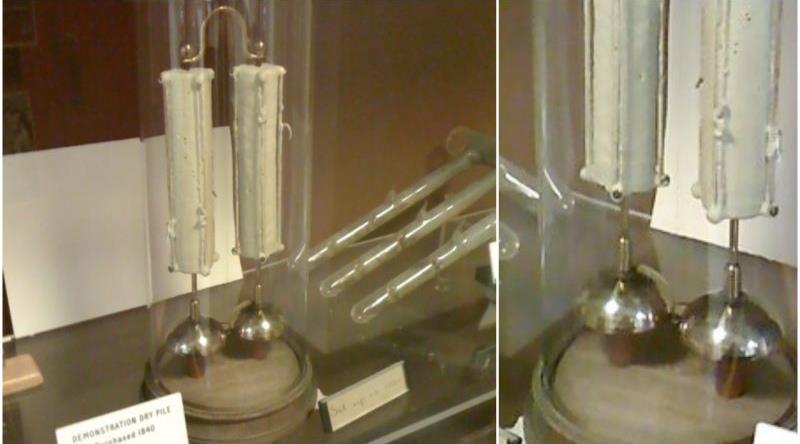
The historic apparatus is said to have been ringing for nearly two centuries.
How Does the Oxford Electric Bell Work?
The mechanism behind the device is deceptively simple yet brilliant. The apparatus reportedly operates on a high-voltage, low-current electrostatic attraction. A small metal clapper is suspended between two brass bells, delicately hanging in the balance.
According to researchers, the power source consists of two dry batteries, which are early examples of voltaic piles. To prevent charge leakage and protect the delicate setup, these batteries are said to be coated with sulfur for insulation. When the clapper touches one of the bells, it receives a tiny electrostatic charge. This charge immediately repels the clapper, sending it swinging toward the opposite bell, which carries an opposite charge. Upon striking the second bell, the charge is transferred, and the clapper is repelled back to the first bell.
Because this electrostatic dance requires an exceptionally small amount of electrical current, the energy consumption is extraordinarily low. This extreme efficiency is what has reportedly allowed the clapper to keep moving back and forth, ringing the bells billions of times over the decades.
Why Has the Battery Composition Remained a Mystery?
While we understand the basic physics of the bell's motion, the exact internal chemistry of the batteries remains unproven. Scientists have a strong hypothesis about what lies inside, but they have never been able to verify it.
Researchers suspect that the dry pile batteries are made of alternating layers of metal foil and paper coated with manganese dioxide. However, this elegant chemical recipe has never been confirmed through direct physical examination. The reason for this scientific restraint is simple: nobody wants to open the casing. Dismantling the apparatus would destroy the hermetic sulfur insulation and instantly ruin the historical continuity of an experiment that has reportedly survived for over 185 years.
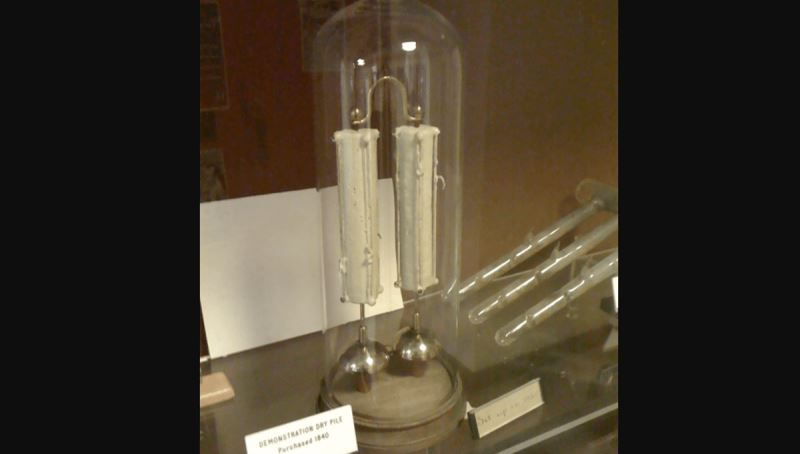
The sealed batteries have kept their secrets safe from curious modern hands.
The Ultimate Waiting Game in Modern Science
This leaves the scientific community locked in a patient, generational waiting game. Physicists and visitors alike can only watch the tiny metal sphere continue its quiet, tireless journey behind its protective glass barrier.
The ultimate answers will only come when the batteries finally run dry and the clapper comes to a permanent halt. Only then will researchers be able to dissect the device, peel back the sulfur coating, and study the exact composition of the dry piles without any guilt or regret. Until that quiet day arrives, the Oxford Electric Bell remains a fascinating symbol of 19th-century engineering, showing us that sometimes the most enduring mysteries are best left untouched.
What are your thoughts on this topic?
Every article is an open conversation. Whether you have a counter-argument, a local example, or a different perspective based on your own experience, your contribution makes this space better.
0 Comments