
The Hartlepool Monkey legend claims that during the Napoleonic Wars in the early 19th century, a shipwrecked monkey was mistaken for a French spy by local people and hanged in the town square at Hartlepool, England. This tale of mistaken identity has become the town's defining folklore, shaping everything from its football club mascot to an actual mayoral election. The story endures because it speaks to a universal fear of the unknown, wrapped in a darkly comic twist that locals have proudly embraced for over two centuries.
The short version
During the Napoleonic Wars in the early 19th century, a shipwrecked monkey washed ashore near Hartlepool, England. Local people, reportedly unfamiliar with monkeys and fearing French invasion, allegedly interrogated the animal and hanged it as a French spy. The legend is unverified but remains central to Hartlepool's identity.
- The alleged hanging took place in Hartlepool, a coastal town in northeast England, during the Napoleonic Wars in the early 19th century.
- The monkey reportedly came from a shipwrecked vessel, likely a French warship, according to the folklore.
- Local people supposedly mistook the monkey for a French spy because they had never seen such an animal before.
- The legend inspired Hartlepool United Football Club's mascot, H'Angus the Monkey.
- Stuart Drummond, wearing the H'Angus costume, won the 2002 Hartlepool mayoral election, partly due to the legend's popularity.
A Shipwreck, a Survivor, and a Very Strange Suspect
The Hartlepool Monkey legend begins on the northeastern coast of England during the Napoleonic Wars in the early 19th century, when Napoleon's France was locked in a bitter struggle with Britain. Locals in Hartlepool, a small fishing town in County Durham, spotted a French ship sinking just offshore. Fear of a French invasion was running high, and the townspeople were convinced they were watching an enemy warship go down.
When they rushed to the wreckage, they found just one survivor: a monkey dressed in a military-style uniform. The creature clambered out of the debris, and the crowd stared at something they had never seen before. Hartlepool sat far from France, and most residents had never encountered a French person in their lives, let alone a monkey in soldier's clothing.
The confusion made sense in its own strange way. British satirical cartoons of that era, drawn by caricaturists like Gillray and Rowlandson, routinely depicted French people as monkey-like creatures with tails and claws. So when the townsfolk saw this small, hairy, uniformed creature, they didn't see an animal. They saw an enemy spy who had washed up on their shore.
The Trial and Execution of the Hartlepool Monkey
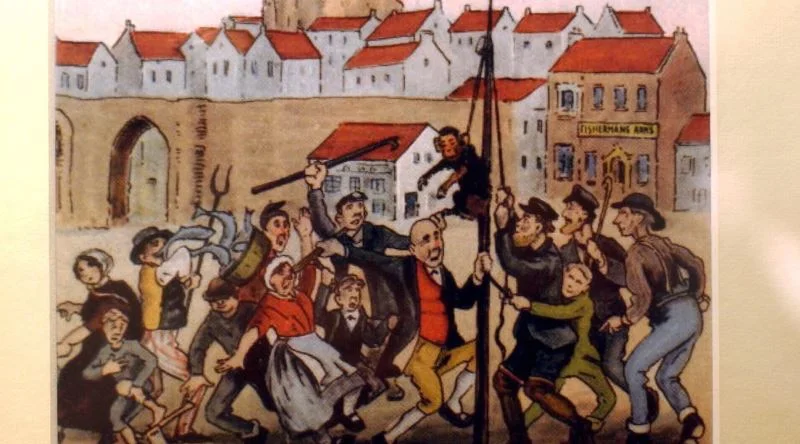
The Hartlepool Monkey was dragged before a makeshift court, accused of being a French spy, and when it refused to answer a single question, the terrified townsfolk found it guilty and hanged it in the town square. That grim scene, set during the Napoleonic Wars in the early 1800s, became the founding myth of Hartlepool's enduring nickname. But the road to the gallows began on the beach, with a shipwreck and a very strange survivor.
It was around the early 1800s, with Britain locked in a bitter war against Napoleon's France, when local fishermen spotted a French vessel breaking apart off the coast of Hartlepool, a port town in northeast England. Fearing an invasion, they rushed to the wreckage. Among the splintered timbers they found just one living creature: a monkey, still dressed in a miniature military uniform. The animal had apparently been the ship's pet or mascot, but the townsfolk had no way of knowing that. Hartlepool sat far from France, and most of the residents had never laid eyes on a French person, let alone a monkey in soldier's clothing.
British satirical cartoons of the era made things worse. Caricaturists like Gillray and Rowlandson routinely drew French people as monkey-like creatures with tails and claws, a propaganda trick that blurred the line between man and beast in the public imagination. To the frightened people of Hartlepool, the uniformed primate on their shore looked less like a lost animal and more like an enemy agent sent to scout their defenses.
So they held a trial. The monkey was brought before the court on suspicion of espionage, and the proceedings went about as well as you might expect. Every question put to the creature was met with silence, or perhaps a chattering screech that nobody could interpret. Unable to mount a defense, the monkey was pronounced guilty. The verdict was followed by a swift and brutal sentence: the townsfolk dragged the animal to the town square and hanged it.
Whether the story is literally true remains a matter of debate, but the legend stuck with a vengeance. The people of Hartlepool have been known as "monkey hangers" ever since, a nickname that started as mockery but has since been worn with a strange sort of pride. Even today, when Darlington and Hartlepool United face off on the football pitch, you can hear the opposing fans chant "who hung the monkey?" from the stands.
Was It Really a Monkey? The Darker Side of the Legend
Historians and folklorists have long wrestled with a troubling question: did the people of Hartlepool actually hang a monkey, or was the victim something else entirely? According to the original account, some speculate the hanged creature might not have been an animal at all, but rather a small child. Others point to a darker possibility involving a "powder monkey", a young boy or teenager whose job on military ships was to carry gunpowder from storage to the heavy guns during battle.
This alternative reading of the Hartlepool Monkey legend emerged because the historical record is frustratingly silent on the details. The story, set during the Napoleonic Wars in the early 19th century, describes a French ship sinking off the Hartlepool coast and locals finding a single survivor wearing a military uniform. But here's where the speculation begins: what if the "monkey" in uniform was actually a powder monkey, a real human boy whose small stature and soot-blackened face might have confused frightened townspeople who had never encountered a French person before?
It's worth remembering how isolated Hartlepool was in those days. Geographically far from France, most residents had never met or even seen a Frenchman. British caricaturists of the era, including Gillray and Rowlandson, routinely depicted French people as monkey-like creatures with tails and claws in satirical cartoons. That visual propaganda could have primed locals to see a primate where a person stood. The theory remains speculative, reported as a possibility rather than established fact, but it adds an unsettling layer to a story already steeped in tragedy.
From Football Chants to a Real-Life Mayor: The Legend Lives On
The Hartlepool Monkey legend didn't fade into history, it became part of the town's living identity. Over two centuries after the supposed hanging, the story still shapes how locals see themselves and how rivals tease them.
Walk into any match between Darlington and Hartlepool United, two football clubs with a fierce local rivalry, and you might hear the chant "Who hung the monkey?" echoing from the stands. It's a taunt that never gets old for Darlington fans, and many Hartlepool supporters have learned to laugh along with it. The joke runs so deep that Hartlepool United's official mascot is a monkey named H'Angus, a playful nod to the town's most infamous legend.
The rugby side Hartlepool Rovers carries the nickname "The Monkeyhangers" with pride, and a statue of the doomed monkey stands in the town today. Visitors can snap a photo with the little fellow who supposedly met his end as a French spy, a permanent reminder that Hartlepool doesn't take itself too seriously.
That sense of humor reached its peak in 2002. Stuart Drummond, a local man, decided to run for mayor in that year's local elections. His campaign strategy? Show up wearing the H'Angus monkey costume and promise free bananas for schoolchildren. It sounded like a joke, and plenty of people treated it as one. But Drummond won the election anyway, then went on to serve two more terms as mayor. The man in the monkey suit became a real-life politician, proving that in Hartlepool, the legend of the hanged monkey carries real weight.
The Monkey Who Became Mayor: Stuart Drummond's 2002 Campaign
In 2002, a man in a monkey costume won a mayoral election in Hartlepool, England. Stuart Drummond ran for mayor dressed as H'Angus, the local football club's monkey mascot, and he actually won. His campaign promise was free bananas for schoolchildren, a pledge he never kept, yet the voters sent him to office anyway.
Drummond's victory was no fluke of a bored electorate. The Hartlepool Monkey legend had already made the town famous for its supposed history of hanging a French spy who turned out to be a monkey. When Drummond put on that furry suit, he tapped into a story centuries old, and the town responded by making him their mayor.
He won re-election in 2005 and again in 2009, serving three terms in total. The man who campaigned as a cartoon primate ended up governing a town, and he did it without ever delivering a single banana to a single schoolchild.
The joke, it turned out, was on everyone who thought it was just a joke. Drummond went from mascot to mayor, and Hartlepool's strangest legend had produced its strangest and most successful sequel.
Frequently Asked Questions About the Hartlepool Monkey
What is the legend of the Hartlepool Monkey?
During the Napoleonic Wars in the early 19th century, a French ship wrecked off the coast of Hartlepool, a port town in northeast England. The only survivor was a monkey wearing a military uniform, and the locals, who had never seen a French person, mistook the creature for a French spy. They put it on trial, and when it could not answer their questions, they found it guilty and hanged it in the town square.
The townspeople had every reason to be jumpy. The Napoleonic Wars had Britain on edge, and when they spotted a French vessel sinking just off their coast, they feared an invasion. Rushing to the wreckage, they found just one living thing among the debris: a small monkey dressed in a military-style uniform. Hartlepool sat far from France, and most residents had never laid eyes on a French citizen, let alone spoken with one. To make matters worse, British satirical cartoons of the era routinely drew French people as monkey-like creatures with tails and claws. So when the townsfolk dragged the chattering primate before a makeshift court, they genuinely believed they were interrogating an enemy agent. The monkey, of course, had nothing to say for itself, which the court took as proof of guilt. They hauled it to the town square and hanged it, and the people of Hartlepool have been known as "monkey hangers" ever since.
Was the Hartlepool Monkey story actually true?
Historians seriously doubt that a real monkey was hanged in Hartlepool around the early 19th century, when the legend is traditionally set. Some darker theories suggest the victim might have been a small child or a "powder monkey," a young boy who carried gunpowder on warships, rather than an actual primate.
The tale has survived for over two centuries, but no contemporary records from the early 1800s confirm the hanging. Some researchers wonder if the story grew from a confusion of words, since "powder monkey" was a real job title for teenage boys who hauled gunpowder from storage to the cannons on naval ships. Others point out that the legend may have been invented by rival towns to mock Hartlepool's residents as gullible country folk. Whatever the truth, the nickname stuck. Even today, when Darlington and Hartlepool United face off in football matches, rival fans chant "who hung the monkey?" at the home crowd, and the people of Hartlepool have learned to laugh along with the joke.
Who is H'Angus the monkey?
H'Angus is the official mascot of Hartlepool United Football Club, a monkey who wears the team colors and entertains crowds at matches. In 2002, a man named Stuart Drummond wore the H'Angus costume while running for mayor of Hartlepool, promising free bananas for schoolchildren, and he actually won the election.
Drummond's campaign was part stunt, part genuine grassroots effort. He could not remove the mascot head during the campaign because of election rules, so he gave speeches and shook hands while sweating inside the furry suit. His slogan about free bananas was widely mocked, and he later admitted he could not deliver on that promise. But the voters of Hartlepool elected him anyway, and he went on to serve as mayor for three terms, winning re-election in 2005 and 2009. The local rugby team, Hartlepool Rovers, also embraces the legend, going by the nickname "The Monkeyhangers." For a story that may never have happened, the monkey has certainly left a lasting paw print on the town.
Editor's note: The core events of this legend are unconfirmed folklore; any details presented as uncertain are clearly hedged in the text above.
What are your thoughts on this topic?
Every article is an open conversation. Whether you have a counter-argument, a local example, or a different perspective based on your own experience, your contribution makes this space better.
0 Comments